He reports for duty at six in the morning on the sixth of August, serving a mess of fifteen men. Within a week the officers are telling each other this is plainly not his first voyage. Within a month he is running a cabin of seven and turning down promotions.
This is the act where he gets it all back, and the journal knows it. The entries get longer, funnier, and considerably more pleased with themselves.
Not his first voyage
Fully in the swing of things now, and perfectly at home. The officers say it’s plain this isn’t my first voyage, judging by how I carry out my duties. While I was getting the coffee ready, in walked the chief mate of my old ship, who’d taken a liking to me and would gladly have kept me on as steward in Germany.
He asked after me and I told him I hadn’t been able to get a ship to Australia, and so had signed on with another steamer for the time being.
There it is. Australia was a settled plan back in Chile in early May — and here it is in August, handled in half a sentence, filed away as a thing that didn’t come off.
He does not mention the park bench to the chief mate. There is no indication he mentioned it to anyone.
The chief steward tells me the captain has been asking after me, and that Captain Ahrens of my old ship had nothing but praise for me. Later the first mate mentioned that once we leave Hamburg harbor, I’d be moved up to first class.
Two weeks ago he was begging the consul for papers. His old captain has been putting in a word for him the entire time and he had no idea.
The dish pan
Ten August, two sentences, entirely characteristic:
We have a watchman aboard whose look I don’t much care for — he has the night watch, speaks English, and strikes me as no easy customer. I’ll keep my guard up in case he’s looking for trouble.
Two days later he has caught the man, gotten him fired, and written it up like an engineering report.
For several nights running, my larder had been tampered with — cheese, sausage, butter, all going missing. Not wanting to raise a fuss before I was certain, I let the watchman know I had my suspicions. He put on quite an air and told me to mind my own business.
To settle the matter, I rigged a trap: a dish pan set to fall and clatter to the floor the moment the safe door was disturbed. My bunk sits right next to the dining room, so I knew I’d hear it if anything happened. Sure enough, sleeping with one ear open, around midnight down went the pan with a bang. Out I went and caught him red-handed.
“Caught in the act, eh,” I said.
He built an alarm out of a dish pan, positioned himself to hear it, slept with one ear open, and then delivered a line.
Caught in the act, eh. He wrote down his own dialogue. He was pleased with it. He should have been.
Two hundred pounds
The chef owes a former steward’s helper fifty-five marks. The man comes down to the dock to collect it and gets punched in the jaw.
The chef weighs about two hundred pounds; the man he hit weighs maybe a hundred and thirty-five. Naturally the smaller man, who was in the right, was getting the worst of it, and naturally I had to step in.
I told the chef twice to let go, and when he paid no attention, I took hold of him and threw him over my back, forcing him to release his grip. I was angry enough to have pitched him overboard, and could easily have managed it given my hold on him, so I braced myself in case he turned on me the moment I set him down. He didn’t say a word.
Two naturallys in one sentence. The smaller man was in the right, and therefore he had to step in — presented as though no other course existed.
Then the detail that makes it real: he was angry enough to throw the man in the harbor and knew he could have, and set him down instead, and braced for what came next.
Nothing came next. He didn’t say a word.
Was more than a little surprised to see the look on our old chef’s and his assistant’s faces when the steward came aboard to fill the vacancy. Needless to say, my meals have been excellent again since.
That is the whole postscript. The chef is gone and the food improved.
Not like this
Something has gone missing from the dining room. The first-class steward and the purser come to search the pantry, and Carl lets them, right up until the moment the steward goes through his coat pockets.
Our steward thought to act smart, saying it was none of my business, and went to go through my coat and vest pockets. That was more than I could stand, and I took hold of him by the collar. He went pale as a ghost.
“Now,” I told him, “you’ll do this properly, or there’ll be trouble. Get the police if you like, let them search — but not like this.”
Get the police if you like, let them search — but not like this.
He is not objecting to being searched. He is objecting to being searched informally, by a man going through his pockets on his own authority. He wants it done properly or not at all.
Nine days after a park bench, with nothing to his name but a job he begged for, he grabbed a superior by the collar over a procedural point.
He threatened to have me put off the ship if I got too bold. I told him to try it. My look said the rest. He went a little pale and had nothing more to say.
That steward was fired nine days later. Carl notes it in a single clause, in a list of other news, without visible satisfaction.
What a bunch of landlubbers
Gave the locals something to talk about tonight, though it seemed a small enough thing to me. Coming back aboard, the watchman had fallen asleep and didn’t hear the boatswain, the second mate, or myself calling out “Boat ahoy!”
Lying as we were some seventy-five yards off the steps where the ferry lands, and seeing no sense in straining our lungs any further, I stripped off and swam out to the boat tied at the steps, untied it, and rowed the others back myself. Word of it has apparently traveled to other ships by now. What a bunch of landlubbers, I thought.
He is standing on the ferry steps with the boatswain and the second mate — two men senior to him — and after some shouting he takes his clothes off and swims seventy-five yards across a working harbor at night to fetch a boat.
Though it seemed a small enough thing to me.
Two months before, in the Thames, he and Adolph rowed themselves out to the Serapis at one in the morning because the boatman had gone home. Same problem, same solution, escalated.
Turning it down
Twice in two days he is offered a promotion to chief steward in second class, and twice he says no.
This morning the first mate, Herr von Appen, asked whether I’d like to take on the role of chief steward in second class. I told him I was quite content where I was. It seems the less a man angles for promotion, the more it comes looking for him — there are stewards who’ve served on Kosmos ships for years trying to land a post like the one just handed to me without asking.
The reason he gives is money, and it is a real reason.
I’ve made it known I’d rather not move up to first class, on account of the extra expense — the uniform, the canvas gown, and the rest that goes with a pantry steward’s post. My work will stay simple: cutting bread, making sandwiches, fetching meals from the galley. I want no part of the back-stairs business that comes with the fancier posting.
He cannot afford the uniform. He was sleeping outdoors five weeks ago; there is no uniform money.
But read the second half again — I want no part of the back-stairs business. Elsewhere he says that from what he’s seen of the first-class stewards, he suspects a few cracked heads would come of joining that crowd.
So the honest version is probably both: he can’t afford it, and he doesn’t want it, and having a real financial reason meant never having to test which one was doing the work.
By late August he has become a favorite of the firemen — the men who shovel coal into the boilers, the hardest and lowest-status job on a steamer. They toast him.
He is an American mess steward on a German ship, and the people who like him best are the stokers. He mentions it twice.
Director of the circus
Have now taken up my new duties as pantry steward, and by all appearances have landed the best and easiest job aboard. My pantry is spick and span, and I’m always turned out in white. My fellow stewards take a certain pride in introducing me to their lady friends as their American chum.
There are seven of us bunking in one cabin — we call it the circus, and a circus it is, I promise you. Today, shortly after noon, the first mate called us all together and, without any preamble whatsoever, appointed me director of the circus, on the understanding that what I say goes.
Seven men in one cabin. The first mate walks in, appoints the American in charge, and walks out. Without any preamble whatsoever.
And then the first thing the new director does is hold a vote.
Once I took the reins, I put it to a vote whether we should keep the place tidy by taking turns at it ourselves or pooling our money to pay the dishwasher to handle it. The latter carried, and we’re all the happier for it.
Handed unilateral authority — what I say goes — and he immediately puts the only question to a vote and abides by it.
Also in that entry, without emphasis: the steward who had been suspended is back among them and getting along fine, no hard feelings on either side. That is the man he grabbed by the collar.
Four of the seven of us bunk together and cut quite a swath when we go ashore of an evening.
Farewell to Hamburg
Sailing day. Passengers aboard from ten in the morning.
Felt a real swell of pride when passengers, the ladies especially, stopped in to admire how tidy the pantry looked.
The purser mentioned again that he’d spoken to the captain, and that I was in line for a promotion whenever I wanted it — chief of second class next time out, and eventually chief steward of one of the line’s own ships.
Eventually chief steward of one of the line’s own ships. In May, off Corral, he wrote that he’d come back someday on his own ship. This is the closest that ever gets.
At 5:30 this evening we were towed away from our pier at Africa Höft, and now, at ten o’clock, we’re steaming out of the Elbe. Farewell to Hamburg for four or five months.
That is the last dated entry in the journal.
He is twenty-four. In the last five months he has run the Strait of Magellan end to end through the worst weather of the year, crossed the Atlantic twice, been rescued from a street fight by a woman he never saw again, pawned everything he owned including the clothes on his back, slept in a park in the rain, begged an American consul for papers, caught a thief with a dish pan, thrown a two-hundred-pound man over his back, swum across a harbor at night on principle, and been made director of a circus.
He has four or five months at sea in front of him and the paper runs out.
What happened to the ships
Carl could not have known any of this, and it is the one place where I know more than he does.
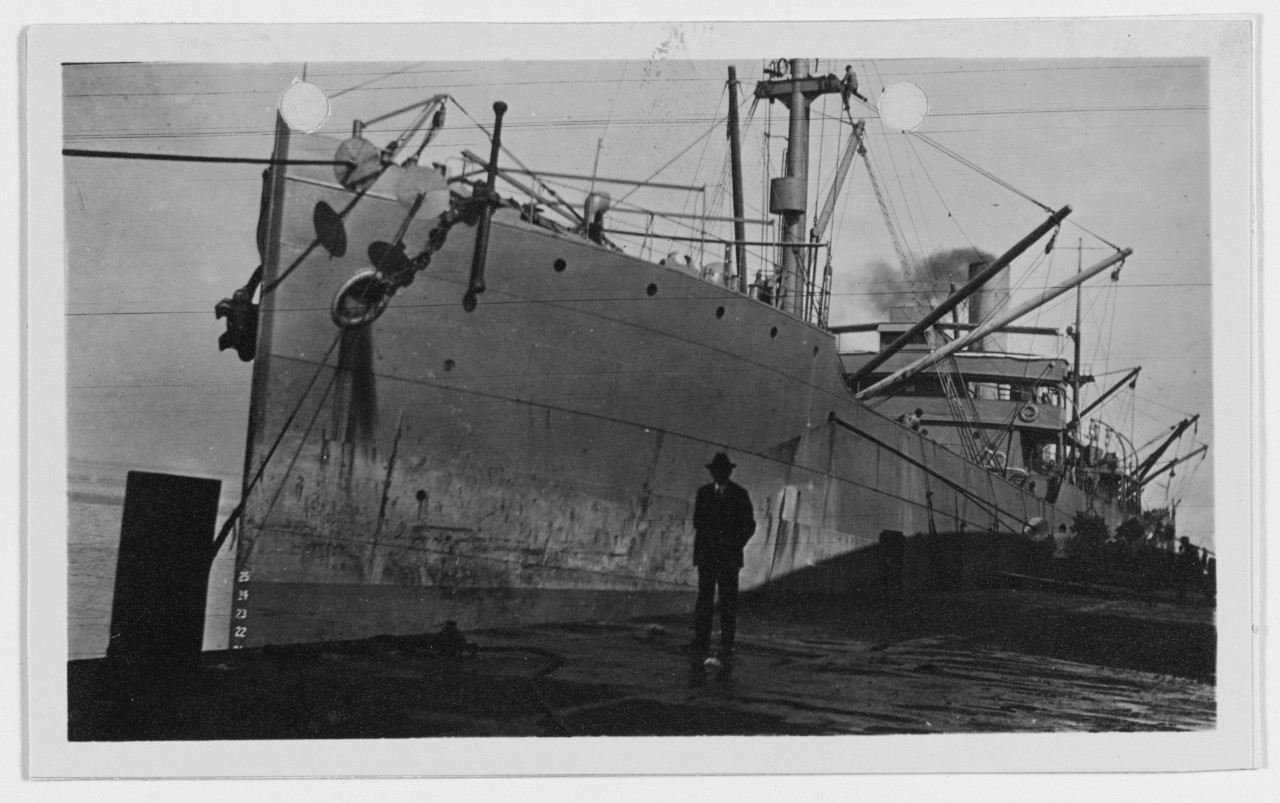
The Serapis was two years old when Carl sailed on her. She kept running the Kosmos route until the war caught her out: she took shelter at San Francisco, was interned there, and in 1917 was seized by the United States government and renamed Osage.
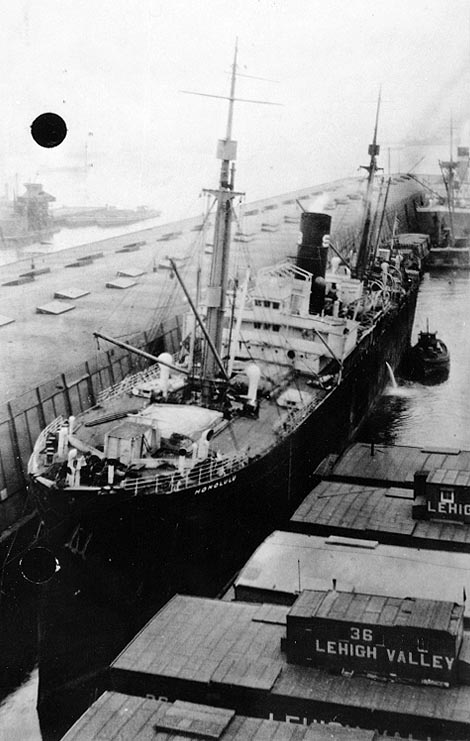
The Setos, the ship he sailed out of Hamburg on that September night, ran the South American route until August 1914, when war broke out and she ran for the nearest neutral harbor she could reach. That turned out to be Honolulu. She sat there, interned, for nearly three years.
The end of the circus ship
Seized by the United States on 12 June 1917. Renamed Itasca, then Honolulu, carrying cargo to France for the rest of the war under a US Navy crew. Sold out of government service in 1920. Renamed again in 1933 — Commercial Trader.
In 1940 she was sold to Lloyd Brasileiro, a Brazilian state shipping concern.
On 16 September 1942 she was torpedoed and sunk about seventy-five miles east of Trinidad by the German submarine U-558.
Thirty-four years after a German first mate walked into a cabin in Hamburg harbor and made Carl Zeus director of the circus, a German submarine sank the cabin.
Carl was fifty-eight that autumn, living in California, with a son in the merchant marine. I have no idea whether he ever knew.
He lived another thirty-eight years after that. Long enough for a house on Shattuck Avenue, and a small great-grandson on the floor of the front room, and a story about a storm off Cape Horn that the boy was too young to follow.
He told them so well it did not matter.
The Circuit
Carl Zeus, 1884–1980