He lived on Shattuck Avenue in Berkeley, and we visited him a few times in the late seventies, when I was very small. What I remember is that he had the best stories of anyone I knew. I could not always follow them. He told them so well it did not matter.
Carl Hammabach Zeus was my great-grandfather. Born 10 June 1884 in Texas, died 4 February 1980 in Berkeley, ninety-five years old — he never quite reached the ninety-sixth birthday, though it is tempting to round up. By the time I was sitting in his front room, mostly not understanding him, he had been telling these stories for seventy years.
I found the notebook a few days ago, in a box in the garage, underneath my grandfather’s Matson Line papers — which is what I had actually been looking for. It is his, from 1908, when he was twenty-four and working as a ship’s steward on the Hamburg–South America run.
Reading it, the thing that struck me was not that I was meeting a stranger. It was the opposite.
Some of this I have heard before. Badly, at the age of six, from an old man in Berkeley who was there.
He wrote it for himself, with no expectation that anyone would ever read it. What it turns out to be, a hundred and eighteen years later, is corroboration.
1884–1980
crossings
DDG Kosmos
end to end
The circuit
Almost every place he names can be put on a map, because he was a careful writer of dates and ports even when he was writing about a hangover. So I put them on one — in QGIS, on the projection a navigator of 1908 would actually have been working in, with the course held to open water the whole way.
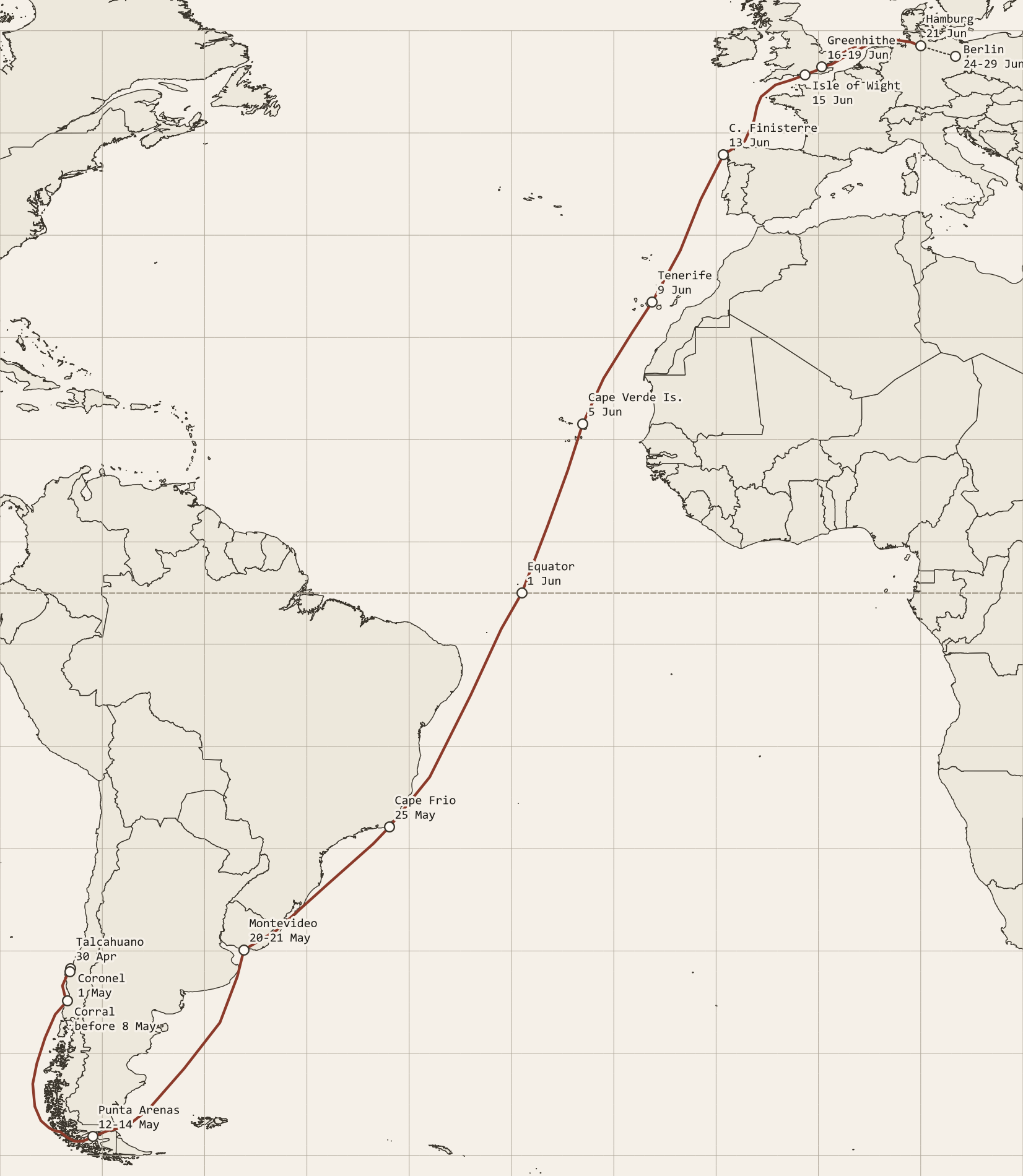
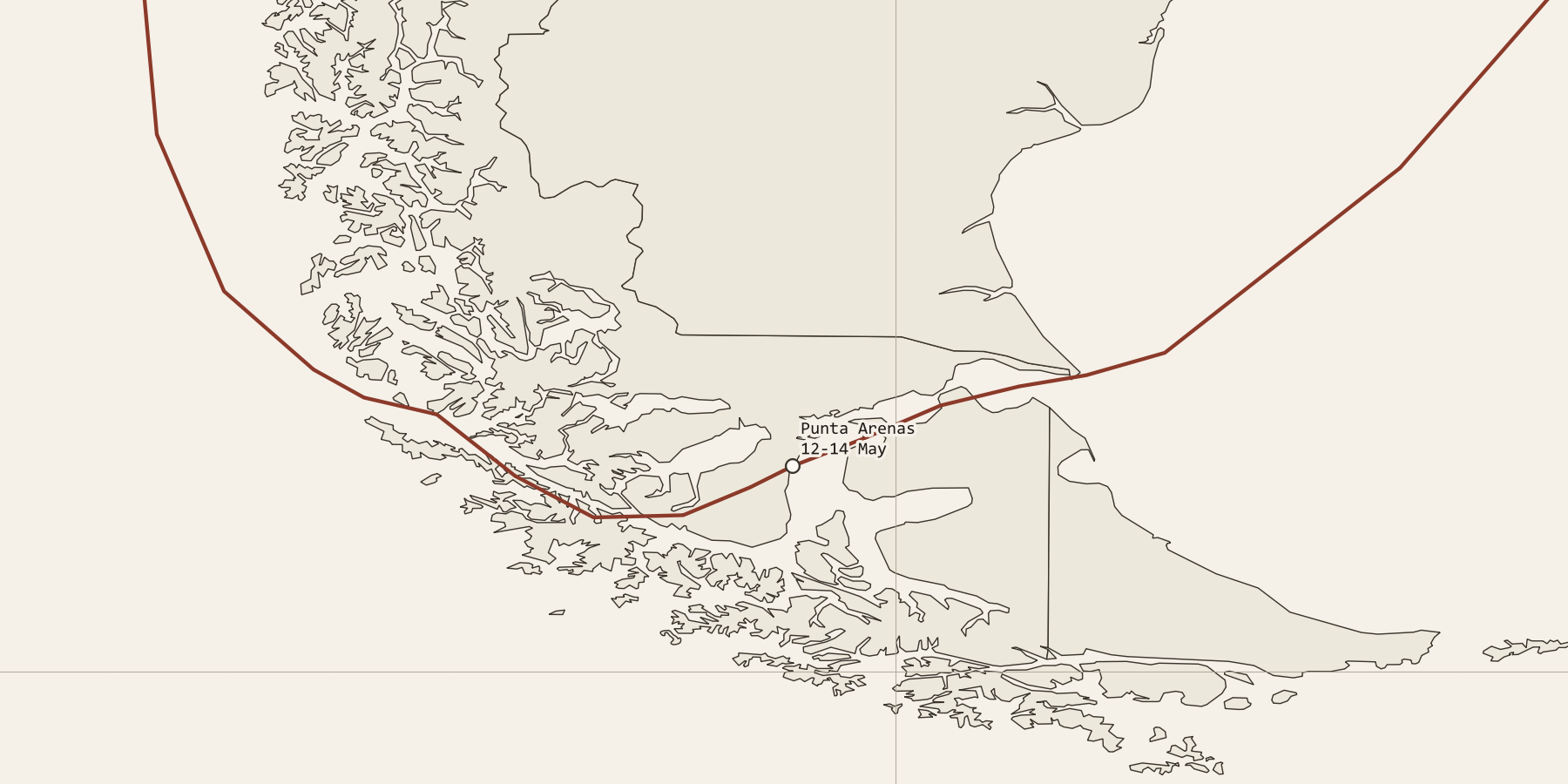
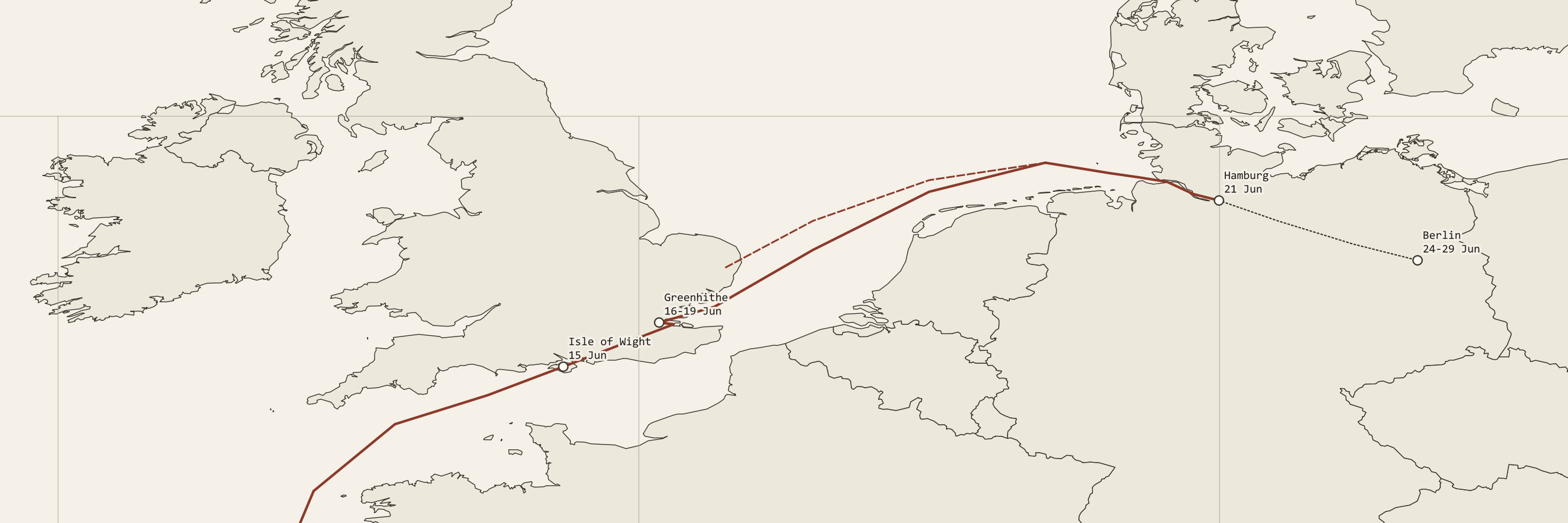
Two details are worth pulling out at larger scale.
Where it opens
The journal begins mid-voyage, because the pages before it are gone. No introduction, no explanation of who he is or how he got there. Just a harbor, assessed by someone who has clearly seen a few.
Talcahuano harbor is the best so far on this voyage. It has two entrances, with an island in the mouth of the bay. This is the stronghold of the Chilean navy — its navy yard and all. There are now within sight eight cruisers and four or five torpedo boats.
Talcahuano has a bad name for lawlessness; the town seems to be a regular nest of refugees from the law who still stick to their trade. There was an incident at a funeral today, when a passenger was relieved of his belongings.
Eight cruisers, four or five torpedo boats, and a man robbed at a funeral. That is the first page I have of him.
He is twenty-four.
Not being seasick
Four days south of Corral the weather turns, and stays turned. This is the passage that would have been the whole point of the story, if he told it — and I think he did tell it, though I could not have said so before reading this.
Still not seasick, while all around me the other stewards are pale as ghosts and unable to eat. Can’t imagine why I should be so immune. My bunkmate said he’d expected it to be the other way around — that I’d be the one laid up. Pride said otherwise.
Pride said otherwise. He is not claiming a strong stomach. He is claiming he refused.
For storms and heavy seas, last night takes the record. Waves broke over the lifeboats on the hurricane deck. Sleep was impossible — one moment standing on one’s head, the next hanging on for dear life. Chairs, stoves, and dishes went smashing through the night. A novel experience at sea, taking coffee on the bridge at midnight. The waves, wind-blown white caps and all, looked like young mountains with snowy tops. Water rushed into our cabin and things washed about like a merry-go-round.
No thought of danger ever crossed my mind — I rather enjoyed the rough weather.
Water in the cabin, the stove loose and sliding, and he goes up to the bridge for coffee at midnight because the view is good.
In May 1908 the Panama Canal was a construction site six years from opening. Every ship moving cargo between the Pacific coast of South America and Europe went around the bottom of the continent, through the worst reliable weather on the planet, or it did not go.
Carl made that passage as routine freight work. Within his own lifetime it became something people did on purpose, for sport.
At four o’clock this morning we entered the smooth waters of the Strait of Magellan. After being tossed about as we were for the last four days, it felt almost as if we were on land, it was so quiet.
That is the whole storm. Two days, one paragraph, and a sentence about how quiet it got afterward.
Erna
Ashore in Germany with money in his pocket for the first time in months, he gets into a fight over a waitress, loses the thread of the evening entirely, and wakes up somewhere he does not recognize.
After a thorough drubbing, the intruder was glad to make his exit. After that I went back to the beer, and didn’t fully come to my senses until the next morning.
The next morning I woke in a handsome room, clearly a lady’s chamber, and slowly coming to my senses, noticed a note on the chair beside the bed.
He copies the note into the journal in full. It is the only document in a hundred pages he thought worth preserving word for word.
Left on the chair · Wedel · 24 June 1908
I stepped in on your behalf. You are not a bad man, I know it. You are a brave one. What money you have left, you’ll find on the table. I wish I could have reached you sooner. Goodbye for good.
Erna.
P.S. I really do care for you, because you are so brave, and I cannot bear to see a brave man treated badly.
She got him out of a fight he was losing, put him in a carriage, took him to her own home, left his remaining money where he would find it, and ended it herself before he woke up.
He never mentions her again.
The three acts
The journal is a log, not a story. It starts mid-voyage because a page is missing, moves day by day, and stops when the paper runs out. But read straight through, something does happen to him across those five months, in three distinct movements.
Twenty-seven years later
The journal was not alone in that box. Underneath it was a letter from Carl’s son Bob — my grandfather, born 31 May 1917 in Anaheim — eighteen years old, working the Matson boats, writing home to his mother. It is short and it is about nothing much.
Bob Zeus to his mother · Los Angeles · October 1935
Dear Mother,
I am very sorry that I missed you, but we arrived right after you left. I thought you said to be there at eleven, and we were there at ten minutes of. I woke Christine up, and she told me you had gone.
Sonny and I went to the auto races that night. I stayed over at his house and caught the 5:30 train back into the city the next morning. Next trip I’ll spend all my time off with you.
Love, Bob.
Both men were barely past being boys. Both were working ships out of a Pacific port. Both were writing home to a woman who wasn’t there when the mail arrived — Carl waiting at Montevideo for letters that never came, Bob turning up at eleven to an empty house.
Carl was fifty-one when his son wrote that, with forty-four years still to go. Long enough to watch Bob work Matson out of San Francisco the way he’d worked Kosmos out of Hamburg.
What the record turned up
A family tree search filled in the rest of it. His mother’s name was Margaret Florence Pattison — not Patterson, which is what I had from the family telling and what I would have written here if I hadn’t checked. She was three years older than Carl, born 1881, and she died on 4 June 1974 in Berkeley, at ninety-two.
Carl outlived her by five and a half years. Which means the front room on Shattuck Avenue, the one I remember, was a widower’s front room. He was ninety-three, ninety-four years old, telling a small boy about a storm at the bottom of the world, some years after the woman he’d been writing to from Montevideo in 1908 was gone.
I don’t remember Margaret at all. I don’t know if I ever met her.
I don’t want to make more of that than it is. But they were in the same box.
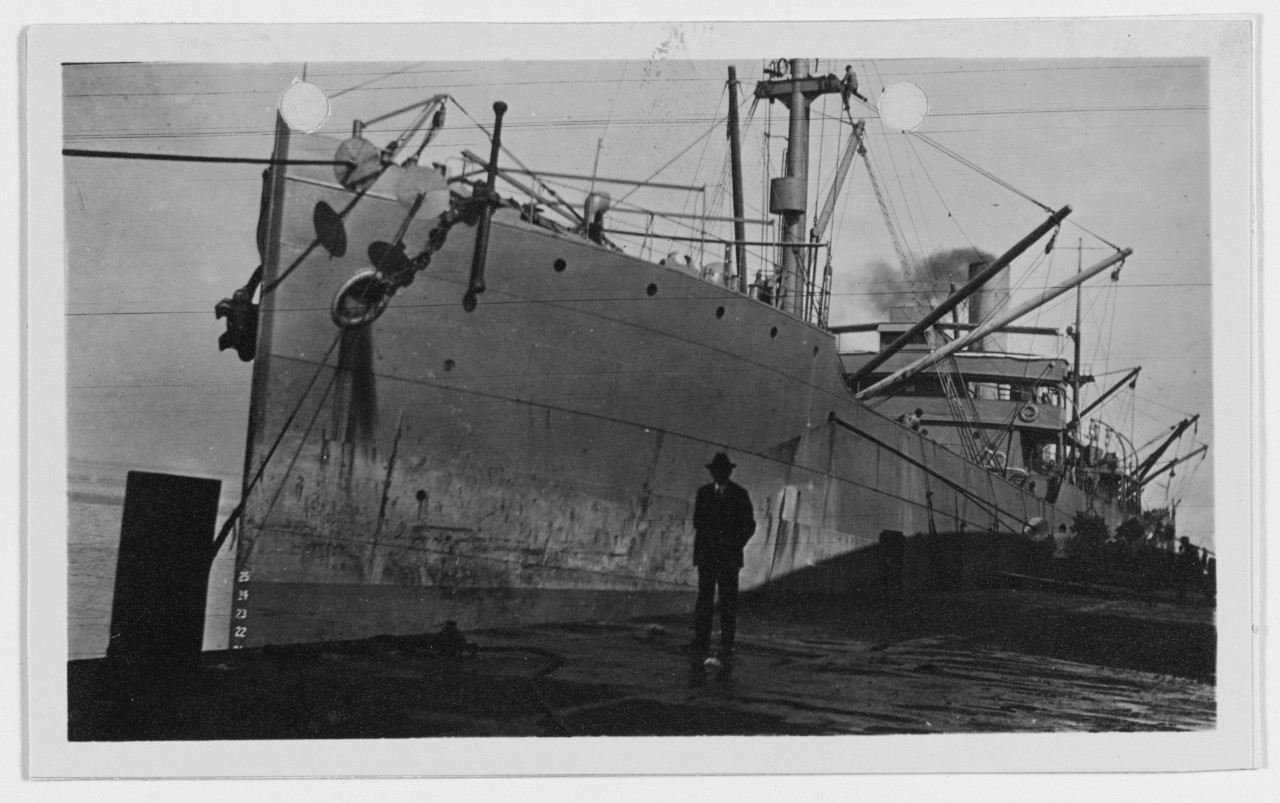
The two ships
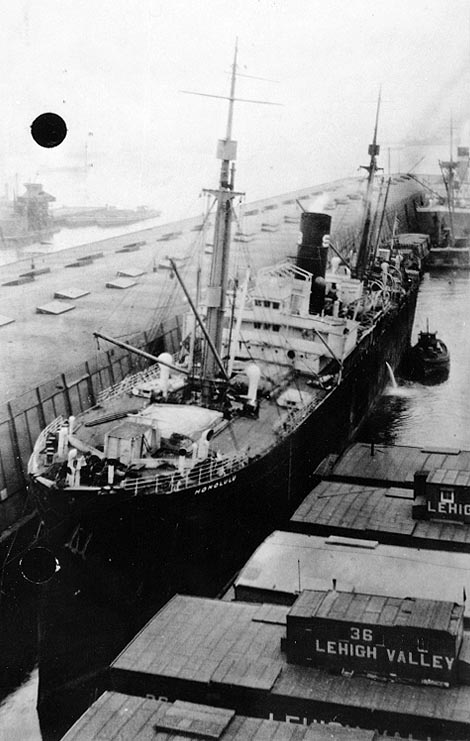
Both of them outlived the world that built them, and neither ended well. Carl had no way of knowing any of it.
What I have not been able to confirm
This is in progress, and I would rather say so than pretend otherwise. Several things in the journal remain unverified against any outside record, and most of them could probably be settled by someone with a free afternoon and better German than mine.
Open questions, in rough order of how fast they should resolve
The crew articles. The Musterrolle for the Setos, signed early August 1908, and the Serapis’s paying-off record from 22 June, should both be in the Staatsarchiv Hamburg — filed under the Seemannsamt on Admiralitätstraße, the exact office and street Carl names himself. That one record would confirm Captain Ahrens and probably identify the ship he calls “the Steuri.”
The Steuri. Neither the ship nor her Captain Werth appears in any Kosmos or Lloyd’s register I can find. The name as written may simply be my misreading of his hand.
Adolph Sutro. Carl records the address twice — 2400 Van Ness Ave, San Francisco — and notes taking his photograph aboard on 7 June. Crocker-Langley city directories for 1907–1915 would settle who he was.
La Guaira. He tells a Venezuela story set “last March.” None of Kosmos’s six published 1908 routes touch the Caribbean. It almost certainly belongs to a different voyage.
Resolved since first publishing: the marriage itself, via a family tree search — Carl married Margaret Florence Pattison, and the record also gave up Bob’s exact birth date and Margaret’s death date. Corrected one thing I had wrong in the process; see the note above.
The Circuit
Carl Zeus, 1884–1980