I decided to do it while I was cleaning a swimming pool.
Five in the morning, a Wednesday in summer, out on the deck at the Harrah’s health club with a net and a hose and nobody else awake in the building. That was the shift. You get the pool right before anyone sees it.
And from that deck, at that hour, you could watch the sun come up the back of the Sierra crest and put light on Mt. Rose — the whole east face going pink and then gold and then plain white daylight, in the space of about fifteen minutes, while I stood there with a skimmer.
The weather had been perfect for days. One of those runs of Sierra summer where nothing is going to go wrong, the sky does not have a single thing in it, and the day feels wider than it has any right to be.
And my weekend started tomorrow.
So I thought: what if I just rode up there.
Over Mt. Rose Highway, over the summit, down the other side to the lake. Have a look at it. Ride home.
I knew the roads. I had a couple of big days behind me by then and I was in the best shape of my life — swimming a mile most days in the pool I was standing next to, lifting, working in a fitness club, twenty-something and built for exactly this and about to spend all of it in one go.
I finished the shift, went home, got my kit together, and slept.
Plumas Street in the dark
Another alpine start. Four in the morning, out the door, downtown and then along the river and then south on Plumas — which is a real street, a main street, and at that hour it belongs to nobody.
No cars. No traffic. Just me heading at a mountain in the dark with the whole thing still to come.
Reno was smaller then. Still developed, still a city, but nothing like what it has become out that direction — the south end was still deciding what it wanted to be. I made good time through the urban part and then the suburban part, and the streetlights ran out somewhere in there, and then I was on Mt. Rose Highway proper.
And that is where it stopped being a bike ride and turned into work.
What this road is
Nevada State Route 431. Twenty-four miles, Reno to Incline Village, and they call it the Highway to the Sky.
The summit sits at just under nine thousand feet, which makes it the highest year-round pass in the Sierra Nevada. Not one of the highest. The highest. Everything else that goes that high closes for winter.
The east side — the Reno side, my side that morning — is mostly four to seven percent. But there is a stretch around miles eleven through thirteen that averages nine, and nine percent is a different category of thing when you are on a hardtail mountain bike with the gearing of 1992.
One pedal at a time, forever
There is no walking this one. That is the first thing you work out. On Peavine you can get off and push and nobody thinks anything of it, because it is a mountain and you are on a trail. This is a state highway. You are in a lane. You do not get to walk.
So it was the biggest gear I had — which is to say the smallest, the one you save — and a cadence, and hours.
I broke it into imaginary checkpoints, which is the only way anybody gets up anything. A turnout up ahead. Sky Tavern, the old ski hill. That particular tree at the top of the next hairpin. You do not climb Mt. Rose. You climb to the turnout, and then you climb to the tree, and then you do it again about four hundred times.
And the light came up while I was in it. Not sunrise exactly — the sun was still behind the Virginias somewhere off my left shoulder — but the gray turning into color, sagebrush and dust down low giving way to juniper and then to real forest, pine and fir closing in over the road around seven thousand feet.
The smell changes as you climb and it is completely distinct. Down at the bottom it is hot dust and sage and asphalt. Up high it is cold and sharp and clean, resin and granite and old snow, and there is a specific line somewhere in the middle where one becomes the other and you can feel yourself cross it.
The whole mountain changes costume three or four times on the way up. You just have to be going slow enough to notice, and I was going extremely slowly.
The waterfalls nobody sees
Here is the thing that only happens at eight miles an hour.
There was still snowmelt running in high summer. Little falls and seeps coming off the rock above the road, in gullies you would never register at fifty miles an hour in a car with the windows up. Water coming down through the shade with nobody looking at it.
You get those for free on a bicycle and you get them nowhere else. That is most of the argument for the whole enterprise, right there.
Magical, and also hard. Those are not opposites and anybody who has climbed anything knows it.
The trash game
And here is the other thing that happens when you are on a road for four hours at walking pace.
You start reading the pavement. Every crack, every patch, every seam where two decades of resurfacing met and did not quite agree.
And you play the game. You spot something far up ahead in the gravel at the edge — a glint, a shape, a color that does not belong — and you spend the next four minutes wondering what it is. Building it up. Committing to a theory. And then you finally grind up alongside it and find out.
It was a Keystone can. Since you are wondering. It is almost always a Keystone can.
That is the level of entertainment available at nine percent grade, and I want to be clear that it was completely sufficient.
Austria, without the cows
And then the road stops going up.
That moment never gets old and it never gets less strange. Hours of one thing and then, without any ceremony at all, a different thing.
The air is thin enough up there to feel — not dramatically, you are not gasping, but there is a lightness in your chest and a slight delay in everything. Cool, even at the peak of summer. The meadows open out on both sides of the road, green and wet and full of whatever grows for eight weeks a year at nine thousand feet.
It looks like what I imagine Austria looks like. Alpine meadow, granite behind it, that particular high clean light.
No fancy cows, though. That is the one thing missing.
I rode over to have a look at the campground up there, because I was curious and because I had just climbed four thousand five hundred feet and was not in a hurry to do anything else. And I remember making a note to myself: this would be the place to sleep if you wanted to acclimate. Camp at nine thousand feet, wake up already up here, start the day with the hard part behind you.
Instead of what I had just done, which was ride up from Reno.
I sat down and ate. I had brought serious food this time, high-calorie stuff, because I knew going in what the day was. That was the one piece of planning I got right.
And I felt everything at once up there. Wrecked and elated and slightly disbelieving and very pleased with myself, all in the same body at the same time.
I did not spend one second thinking about the fact that I would have to climb back over this thing in about four hours.
That was a problem for future me. Future me was going to have some thoughts about that.
The postcard
And then the reward.
Twenty-seven hundred feet of descent to the lake, and you cannot buy this. There is no ticket. There is no version of this you can arrive at any other way. You earn it by having spent four hours going the other direction, and the exchange rate is excellent.
The Paragon held it beautifully. That bike never once gave me a reason to doubt it.
And then the lake comes into view, and there is an overlook on that side where you can stop and take the whole thing in, and I stopped.
It looks like a postcard. It looks like every postcard. But better, because a postcard is four inches across and this was the entire world in front of me, twenty-two miles of it, that specific blue that does not photograph properly and never has.
Why it is that color
Lake Tahoe sits at 6,225 feet and goes down 1,645 — the second-deepest lake in the United States, eleventh deepest in the world. It holds enough water to cover the whole of California more than a foot deep.
It never freezes. Too deep, too much thermal mass, always turning over.
And the blue is a function of purity and depth together. Very little in the water to scatter light, and a very long way down for the light to go.
I flew down the rest of it into Incline Village and it was still only mid-morning. Just like Truckee on the Dog Valley ride — I arrived somewhere at an hour when the place was still getting up, having already done an entire day.
Income Village
Incline is a wealthy town and everybody who lives near it calls it Income Village, and I did not feel out of place there for a second.
It is an active place. A dirtbag on a bike covered in dried salt is completely standard equipment in Incline Village. I knew my way around, I had friends up there, and nobody looked at me twice.
Although I will say: most people were going to work. I was the only one who had gotten there from Reno under his own power at nine in the morning on a Thursday.
So I had that going for me.
I got a coffee and something to eat, because I had earned both, and took them down to the beach.
The whole place to myself
Thursday morning in summer, and there was nobody there.
That is the part I would not have predicted. A beach on Lake Tahoe, a perfect day, and I had the entire thing. Everyone was at work. Everyone is always at work. That is the secret of a Thursday.
The water was flat calm. Rocks along the edge to sit on. The bike leaned against a picnic table where I could see it, because you always know where the bike is.
And I was disgusting. Let us be accurate about this. Six hours out, four and a half thousand feet of climbing, dried sweat in layers, salt on my arms and in my eyebrows, road grit stuck to all of it.
The swim was not the plan. The swim happened because I got there and there it was.
Getting in
I was a lifeguard at Harrah’s. I swam a mile most days. Water is not a thing I am nervous around — it is somewhere I have always felt alive and part of, rather than a visitor.
None of that helps with Tahoe.
What that water actually is
Surface temperature in high summer runs about 65 to 70°F, which sounds entirely reasonable written down and is not reasonable at all in practice.
A few feet down it stops being reasonable and stays under 50°F all year, every year.
Cold water shock is a documented hazard here, not a figure of speech — the gasp reflex, the spike in heart rate, the loss of breath control. An average of seven people drown in that lake every year, and cold is a large part of why.
And I had arrived at the water having just dropped twenty-seven hundred feet, soaked through, with my core temperature already doing something unusual.
You go in and it takes your breath. Immediately and completely. There is a moment where your chest locks and your whole body files an objection, and then a few seconds later it lets go and you are swimming.
It was not a long swim. Nobody has a long swim in Tahoe.
But it did the thing. All that salt and grit and six hours of effort came off me in about ninety seconds, and what replaced it was that specific electric clarity you only get from cold water — the reset, where everything from the neck down reports in at once and your head goes completely quiet.
Refreshing, invigorating, cleansing. All three words, all of them earned, and I do not use any of them lightly.
Then I got out, because you get out.
The rocks
And I climbed up on the rocks along the shore and lay there in the morning sun.
That is the best twenty minutes of the entire day and possibly of that entire summer. Cold granite going warm underneath you. Sun on wet skin at six thousand feet, which is a different sun than the one at sea level — more direct, thinner air, you can feel it working.
The lake absolutely still. Nobody on it. A pine somewhere behind me doing whatever pines do.
I ate. I dried. I lay there and let all of it settle.
And then I stretched, deliberately, because I was not finished. I had ridden a bicycle from Reno to Lake Tahoe, which was the entire idea, and the entire idea was only half done.
I still had to get out of this basin.
Future me
Out past the Sierra Nevada College — a small private school then, part of the university system now — and onto the west side of the highway, going up.
And this is the part.
All that glorious free descent I had taken that morning, every foot of it, was now an invoice. Twenty-seven hundred feet back to the summit, from six thousand two hundred to just under nine thousand, in the middle of a hot summer afternoon, on legs that had already done four and a half thousand feet before breakfast.
It was long and it was slow and it was genuinely difficult.
And it was beautiful, which somehow made it worse and better simultaneously. The lake dropping away below and behind, bigger with every switchback. The forest. The meadows opening up again near the top.
Everything in my body was reporting at once by then. Chills and heat at the same time, which is what happens. Sunburn coming up on my arms and the back of my neck. Wind. My legs. And my backside, which had been on a bike saddle since four in the morning and had opinions it had been saving.
But there was no version of that afternoon that did not involve going back over the top. Home was on the other side of it. That is the whole arrangement.
Same as Dog Valley. No option except to continue.
Up past the meadows, and eventually the road stopped going up again, for the second time that day.
Second summit
I took a long break at the top. Longer than the first one.
And I did the maintenance, which I remember specifically. Checked the tire pressure. Went over the brakes. Looked at the bike properly, because I was about to descend four and a half thousand feet on it and that is not the moment to discover something.
Did the same for myself. Water. Food. Sat down and let the legs come back.
They felt all right, actually. Better than they had any business feeling. But I knew I needed to be moving, because it was afternoon in the Sierra in summer and that is not the time of day to still be at nine thousand feet if you can help it.
The blur
And then the long one.
Four and a half thousand feet of descent down a state highway, and there was traffic now — early afternoon, cars going where cars go, and I had to actually pay attention in a way I had not needed to at five in the morning.
People looked at me. You could see it as they went past. This guy is out of his mind. Which was fair.
Every hairpin I had studied on the way up, every crack in the pavement I had spent four minutes analyzing, every piece of roadside trash I had built a whole theory about — all of it came back at me in a blur, in a few minutes, with the wind pulling tears sideways out of my eyes.
That is the strangest part of an out-and-back. You get the whole day in reverse at twenty times the speed. Everything you studied you now cannot see at all.
And the heat came up to meet me. Every hundred feet down, warmer and thicker, pine giving way to juniper and then sage and then the valley, which by mid-afternoon in July is an oven with a city in it.
Thomas Creek
Down where I came off the main highway, near Thomas Creek, there is a gas station.
I rolled in and stopped and I want to give that gas station its due. Snacks. Gatorade. Shade. A place to sit down after forty-five minutes of unbroken descent, which is its own kind of tiring in a way people who have not done it do not believe.
You are not pedaling, but you are braced. Hands, shoulders, neck, everything locked and vibrating. Getting off the bike at Thomas Creek was as good as anything that happened at the lake.
Then the last of it. North, back toward town, concentrating on traffic because it was late afternoon by then and I was tired and that is exactly when people make mistakes.
And then the river. And then the Arch.
Two German beers
I stopped at Bavarian World on the way in and bought a couple of German beers, because I had been thinking about them for approximately eleven hours.
I do not remember seeing Hans that day. He may have been there. I was in no condition for a conversation and I suspect I did not go looking for one.
Then across the street and into the house, and a shower — which is a religious experience after a day like that, and I will not be talked out of that framing.
Fourteen hours, roughly. Out at four, home at six.
What it actually was
I never knew the numbers. No computer on that bike, no way to find out, and I would have told you at the time that it did not matter.
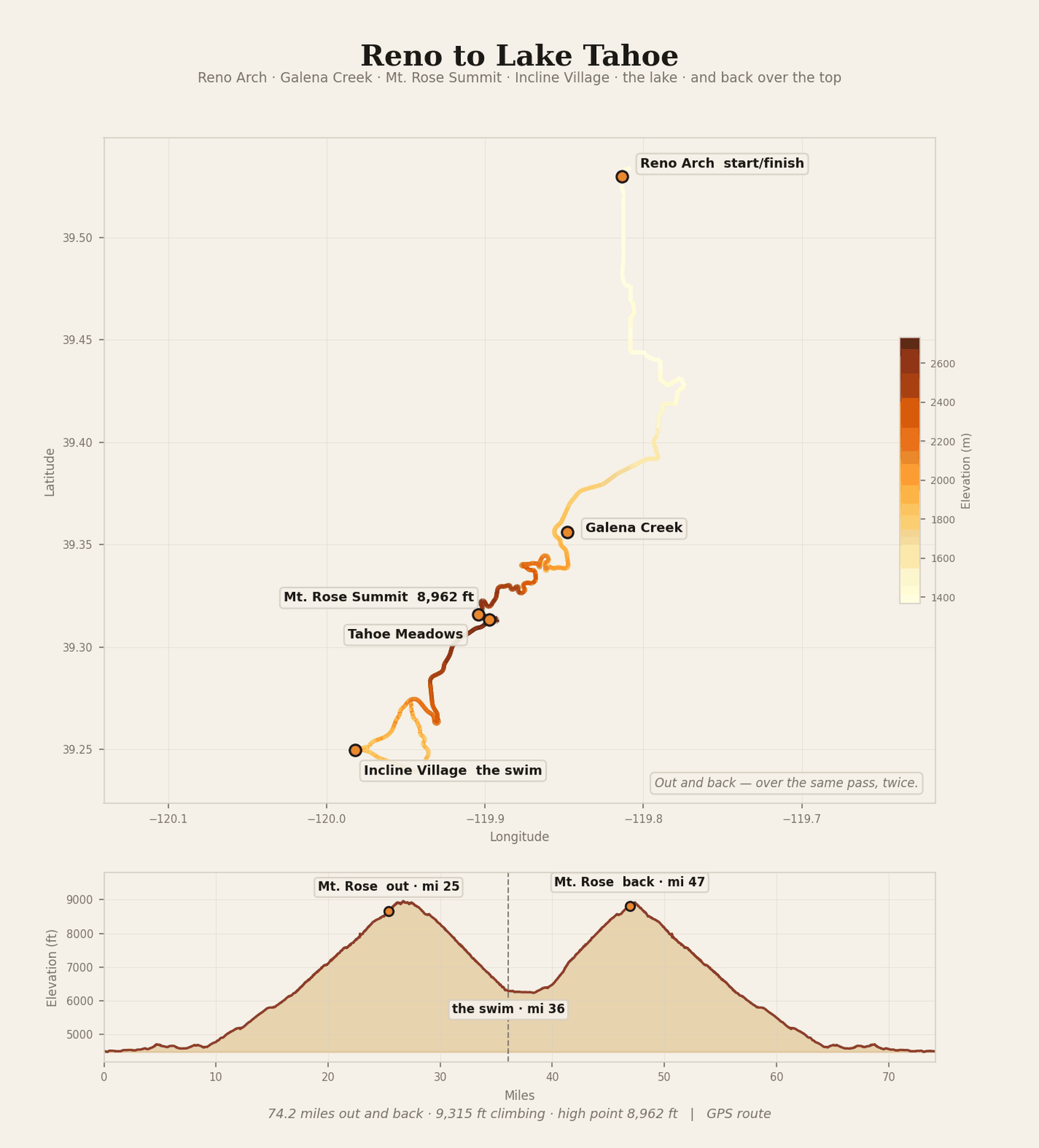
Drawing the route properly, decades later:
The numbers
74.2 miles. 9,315 feet of climbing. Low point 4,483 feet in the Truckee Meadows, high point 8,962 at the summit — twice.
Summit at mile 25. The lake at mile 36. The summit again at mile 47.
For comparison, the Dog Valley ride was three miles longer and had two thousand two hundred feet less climbing in it. This is the biggest day I ever had on that bike.
Nine thousand three hundred feet. I would not have guessed that. I would have guessed something respectable and been wrong by a couple of thousand.
And I never did it again. That was the point of it — not to have a route, but to find out whether the thing was possible. Once you know, you know.
Seven strangers
I got cleaned up and went to my room with the beers and turned on the television.
And what was on was the first season of The Real World.
MTV premiered it on 21 May 1992 and ran the thirteen episodes through 13 August. Seven strangers, ages nineteen to twenty-six, filmed for three months in a loft in SoHo. They were paid twenty-six hundred dollars each.
Nobody had seen anything like it. It is generally reckoned to be the beginning of modern reality television — every single thing that came after it comes from that loft.
So this was the summer of 1992, and I can be sure of that because of what was on television.
Seven people my age, in an apartment, with cameras on them, having their ordinary lives recorded and broadcast because somebody had worked out that watching young people be young was itself the entertainment.
And I was sitting on a bed in a rented room off East 6th Street with sunburned arms and a German beer, having that day ridden a bicycle seventy-four miles over a nine-thousand-foot pass twice, swum in the coldest famous water in America, and come home, with no camera anywhere near any of it and no proof it had happened except that I was extremely tired.
What kind of world are they in. What kind of world am I in.
I did not resolve that. I was twenty-something and drinking a beer and my legs hurt.
But I have thought about it since, and I think the honest answer is that they were at the front of something and I was at the back of something. Theirs was the world that was coming — watched, recorded, performed, everything counted and shown to somebody. Mine was the older arrangement, where you went out and did a thing and the only record of it was in your own legs.
Nobody was watching. Nobody knew. There was no computer on the bike and no photograph of the lake and no way to prove any part of it, and it did not occur to me for one second that any of that was a problem.
I knew. That was the whole of it. I knew.
The Highway to the Sky
Reno to Lake Tahoe · summer 1992