I was cleaning the pool at Harrah’s one morning, early, before the guests were up, and I looked north the way you always do in Reno — and there it was, the way it always was. A big humped mountain with towers on it. And I thought: what is going on up there. I am going to go up there on my bike and find out.
That is the entire origin of it. There was no more to it than that.
I was twenty-something, I lived at East 6th and Valley in a part of downtown Reno that looked a little rough, I worked at the Harrah’s Health Club, and I had a black Gary Fisher Paragon that I kept in my bedroom so I could see it.
Curiosity is my compass.
Twelve hundred dollars
It cost twelve hundred dollars. I maxed out a small credit card to get it and cut back on nights at the casino to pay for it, which tells you something about the decision, because I was a lifeguard and a college student and twelve hundred dollars was not a number I had lying around.
I nearly bought the Hoo Koo E Koo instead. There was another bike a level above the Paragon too. This one was the best middle-grade performance bike I could logically afford, which is a sentence I still recognize as how I make decisions.
The salesman told me it was built for the terrain around Reno. I have no idea whether that was true or whether it was a thing he said to everyone, and I did not care then and I do not much care now, because it turned out to be true in practice.
Aluminum frame, all black. Grip shifters — the dial-them-in kind, which I loved. Continental tires with serious knobs. A drivetrain one grade below XT, because the price difference mattered to me then and, if I am honest, still would. Clipless pedals, which put me on the ground once about ninety seconds into the first ride.
Light enough to lift with two fingers and hold over my head. Compared with a bike in 2026 it is a tank. At the time it was the lightest thing I had ever owned.
They fitted it to me properly, dialled the whole thing in. And once I got it out and rode it around it stopped being an object. Better than a horse. A real human-powered tool, and a good piece of engineering, and an extension of my body.
What it made me feel was that the doors had come off. I could climb those mountains and fly down the other side and hop over rattlesnakes and get across campus and out to friends’ houses on the far side of the city. The bike was the thing that made the Truckee Meadows reachable.
The easier part
You start early. Late spring through early autumn, first light, home by early afternoon, cashed out. Get high before the sun starts cooking, because there is no shade on that mountain and the wind picks up hard between two and four.
In the pack: as much water as I could carry, which was about three litres in a primitive CamelBak with a Gatorade-ish mix in it, sometimes a filter. A couple of PowerBars, which at the time seemed like a miracle of sports nutrition. An orange or two. A tool roll with a chain tool, like a big Swiss Army knife. Tubes, always — it is the desert. A signal mirror. A USGS topo. And a cocktail-napkin map drawn by a guy in valet at Harrah’s who was crazier than all the rest of us put together.
And the yellow sport Walkman, with tapes. Pearl Jam Ten on heavy rotation. The B-52’s Cosmic Thing. Nirvana Bleach. Midnight Oil.
The first hour is not the mountain. The first hour is getting out of town — up out of downtown, through subdivisions that get nicer the higher you go, all the way up to McCarran, the road that rings the Truckee Meadows. Urban decay falls away behind you by degrees. Then you cross McCarran, which is busy, and you cross it fast.
And then the Keystone Canyon trailhead, which in 1994 was nothing at all. No sign. No parking area. You had to know.
What that trailhead is now
Paved parking. Bathrooms. Reviews. It is on Google Maps and there are people there.
None of that existed. That is not nostalgia, it is just the fact — you needed a napkin from a man in valet parking to find the start of the ride.
Civilization drops off within about a minute of that trailhead. You stop watching for cars and start watching for rattlesnakes and wild horses.
Click to enlarge
What it actually was
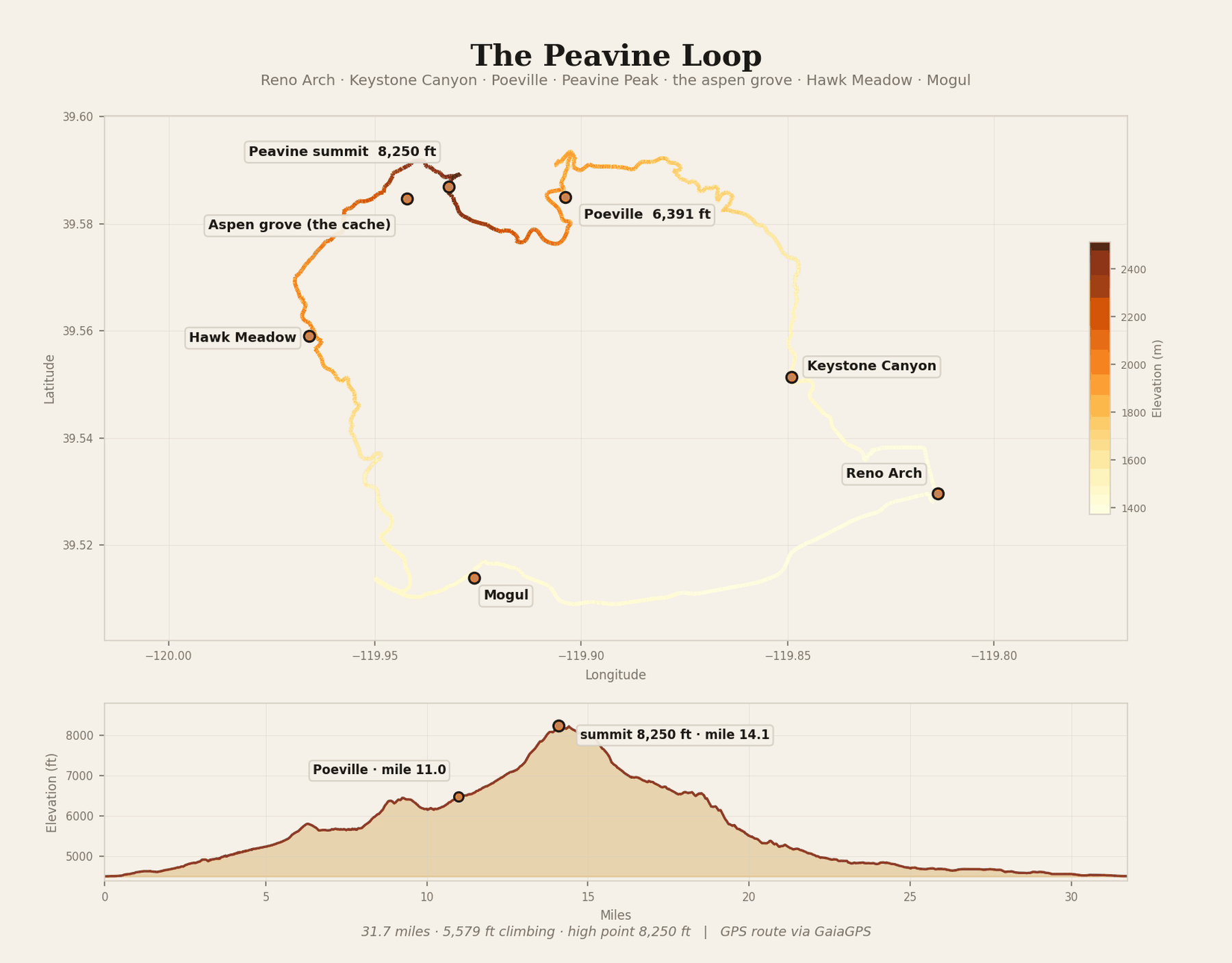
I never knew the numbers at the time. Nobody did — there was no bike computer on the Paragon and no way to find out short of a map and a piece of string. Drawing the route properly, decades later, it comes out at:
31.7 miles. 5,579 feet of climbing. Low point 4,505 feet at the river, high point 8,250 at the towers. Poeville sits at mile 11, three miles and about 1,800 vertical feet below the summit.
Which is more than I would have guessed, and probably more than I would have set out to do if somebody had told me first.
An ocean of sagebrush
Wide at first, steeper than you think, and then single track for days.
Rocky — big old boulders, loose talus, desert rock all over. Flat tires were many and varied. Dry, because it is the Great Basin and it is dry as hell. Junipers along the stream banks and not much else down low.
And sagebrush. An ocean of it. If I close my eyes I can smell it right now, and stronger after rain.
The climb is gradual and brutal at the same time, and you just have to focus on it. Spinning comfortably, then grinding, then standing on the pedals even though I knew even then that standing costs you.
The Paragon climbed like a dream. Light, all the gears, every tooth still on every cog. Made for exactly this, just like they said at the shop.
Tires on gravel — snap, crackle and pop, low and steady, more of a grind than a hum, moving with me.
The chain slapping around. The derailleur, fine mostly, noisier when it got dirty, and I was changing gears constantly.
My own breathing, heavy and varied. Blue jays and hawks and others I could not name. And the wind, which no matter what direction I turned was always coming straight at me, warm and dry, like riding into a giant heater.
And underneath all of it, a whole lot of nothing.
The climbing had a meditative quality to it that I would not have used that word for at the time. What I imagined, and I imagined it often, was a giant rubber band pulling me up the hill.
A little dirty Lego town
There is a moment coming out of Keystone Canyon when you look back and realize you are above the big water tank on the hill, and the city is down there.
Higher, and you get the whole Truckee Meadows. Mount Rose to the south. Highway 395 bending away toward Carson City. Sparks, and I-80 running out toward Lovelock. The casino towers, all of them.
Harrah’s was one of the biggest then, so you always knew exactly where it was. Something out of Lord of the Rings, sitting there in the middle of it.
The city looked like a toy train set. A little dirty Lego town.
And I would think about the people at the Health Club and the swimming pool, doing what they were doing down there right now, and sometimes I did wish I was swimming instead of grinding up a mountain. Yin and yang.
What I noticed most was how quiet it had gone. The urban world dropping away by degrees until it was just me and a few birds watching me ride past.
Rattlesnake mansions
Northern Nevada is mining country, old and new, and this stretch is a spiderweb of chaos — roads going everywhere, and you knew they had been looking for something.
Foundations. Rusted metal everywhere, a real mess. Tailings, all played out. Cans by the mountain-load, all rusted through. Some dilapidated wooden structures that you could not identify, which I mentally filed as rattlesnake mansions. A rock wall here and there.
The whole area looked abandoned in a way that felt like the end of the world. Post-apocalypse.
And you cannot ride through that without thinking: people used to actually live up here.
A hardscrabble life and a tough world. And then maybe they found something. What was it like to be the last person living here — what was that day like? Why here? Why look here, out of all this desert? Did they ever find anything?
What triggered it was never the ruins themselves. It was the wind moving over rusted metal, making it creak and stretch. A jackrabbit bolting in the brush. Small sounds in a place with no other sounds in it. Spooky enough that you did not linger. You could feel the unsettled energy of it.
What that place actually was
Poeville. Also called Poe City, and Podunk. A mining town established in 1864 after John Poe — a promoter from Michigan, said to be related to Edgar Allan — found gold and silver veins on these slopes in 1862.
It sits at 6,391 feet on the northeast flank, which puts it right on the climb, about mile 11. The mountain got its name from the same ground: prospectors found wild pea vines growing near Peavine Springs, just there by the camp.
At least two more townsites went up nearby and did not last — Webster, platted August 1873, and Brooklyn, settled March 1875 on the southeast face.
So the spiderweb of roads makes sense. They were not looking for something. They had found it, and then it ran out.
I was maybe not so different from those old miners. Out there looking for something, on a mountain, on my own.
Why the hell am I doing this
After the canyon and the single track, the utility road up the mountain might as well have been the autobahn. Wide. Maintained, more or less. And after what you have just ridden, straightforward.
Also very steep, very rough, rocks and potholes and rockslides and washboard that set the whole bike vibrating.
And endless. It felt like I had been in the desert for days.
You walk parts of it. It gets steep enough that you walk. The bike could take it — the bike could always take it — but my fitness could not, always. A long hot slog, with the views getting better every hundred feet.
I stopped a lot. To let my body catch up with the elevation, and to look at what was behind me, and because once I could see the towers I knew I was actually getting somewhere.
I ate my oranges and my PowerBars. I rationed the water, three litres that mostly made it and sometimes did not. I sweated constantly and it dried instantly in that air, so I ended up crusted in salt like something painted. Gross, and also fascinating.
I swore a lot, because there was nobody out there to hear it. I laughed like a hyena. I muttered at myself — an old miner in the Nevada desert with a stubborn mule, except the mule was the bike.
Why the hell am I doing this? I asked that many times, most times.
And then I would look at where I was, and what I had done, and that I had done it by myself.
The towers were singing
Radio towers. TV towers. Antennas, more than a few, big ones, transmitting who knows what. Concrete bunker buildings. Barbed wire around the critical infrastructure. Guy wires. Some solar panels, a few generators not running. Signs telling you where you could not go — though it is public land, and we had a right to be there.
And the sound.
The towers were vibrating in the wind. A very low-frequency hum underneath everything, metallic vibration off the structures and the wires, buzzing, resonant. The wires sang, and the pitch changed when the wind gusted, running through frequencies.
You could feel it as much as hear it. You could feel the ground carrying it.
No traffic. No human noise at all. Sometimes a plane, and during the Reno Air Races the racers would come over the mountain before dropping to the course, and sometimes the Blue Angels. Mostly nothing.
So the only sound in the entire world up there was the machinery: the towers humming, and clicks and whirs out of those concrete boxes, doing whatever they were doing. Watching. Listening. Transmitting. Very X-Files.
KUNR came off that mountain. When my dad was a ranger at Frenchman Lake, KUNR was the only AM station we could get, and it was being transmitted from right here, from the thing I was now standing next to.
All the music any of us listened to came off this mountain. All the television. Every signal that reached every house in that toy town below me was leaving from the structure humming eighteen inches from my hand.
I was nervous up there. All that energy and technology, and me alone with it, wondering what it was doing and how much electricity was running through it and what would happen if lightning hit — I was ready to leave immediately if it ever did.
It felt like I was the conduit to something bigger, even though I was the only one out there.
Deep thoughts, after burning three thousand calories to get to them. What they were all doing down there. What I was doing. What any of it means. Transmitting, receiving, all of it — and me in the middle, listening to Channel Z on a yellow Walkman.
A different mountain entirely
You take a long break up there. Look at everything, rest, enjoy it. And then it is time to go, because there is still a lot of trail between you and the house.
This is the exhilarating part.
Go over the top and Peavine stops being the mountain you see from Reno. The change is almost immediate: desert on one side, and on the other, mountains and woods. Snow patches surviving into late summer. Pines and aspens and sagebrush all mixed together, a proper high-elevation transition zone. Cooler, shadier, seven to eight thousand feet and out of that direct sun.
And you cannot see Reno. Not any of it. No urban anything. That is the real transition — on the front side you always knew the city was there. Mos Eisley, Zack and I used to call it. On this side you are somewhere else entirely, back in the old west, with sheepherder camps and mining roads and trees and springs.
The descent is fast and it is long. Ten miles or more of solid downhill to Mogul, most of it excellent ground — if more people had ridden it, it would have been blown out and dusty. It was not. It was solid.
A few dry stream crossings full of sand, which will absolutely put you down if you are careless. Some rocks, nothing like the way up. Long smooth stretches that felt like a gift.
I laughed the whole way down like a little kid. The Paragon flew. It was built for this.
The carvings
Coming down off the summit you drop into aspens.
After the stark high desert of the climb, a lush spring-fed grove with green meadow in it is a genuine surprise. It made me stop. It makes anyone stop. Bright white trunks, green leaves, a couple of hundred trees, wind moving through them completely differently than it moved through those towers twenty minutes earlier. Shade, after hours without any.
It smelled sweet. Chlorophyll and oxygen and organic matter — things entirely absent from the other side of the mountain, which has its own smells, sagebrush and juniper, but not this.
And in the flattest ground near the water, with the trees breaking the wind, people had camped.
Rock circles that might have been corrals or windbreaks. Old fire remnants, long since broken down. Rusted cans, though not on the Poeville scale. Broken bottles from maybe the 1930s. Random strands of barbed wire and the odd fence post. Nothing still usable. Nothing standing.
And then you look at the trees.
What is carved into them
Names I could never know. Initials — lots of initials. AB + BG, that kind of thing. Dates from the 1940s and 1930s, and the oldest I found, I believe, from the 1920s.
Spanish names, and many Basque names, which is a related but different thing.
And pictures. School buses. Lady parts. Men parts. All of that sort of thing.
Dozens of them. Cut into the bark decades ago and grown with the trees ever since — and it is harder to do than you would think. You have to make the marks small and let time do the rest. It is a process.
They looked several decades old and they looked like they were put there yesterday. Remarkable condition.
It is a glimpse straight into the minds of the people who were up there, alone, for a season, with sheep. What else are you going to do.
I thought about that a lot. The stories they must have had. The reasons for being there. What was actually going on in the hearts and minds of the people who came before me to the exact spot I was standing in.
Years later — 2008 — I went back and put a geocache in that grove. Basque Sheepherder: The High Camp. I wrote in the description that it is like a time capsule in the mountains, and that if you rode a mountain bike up here you would be blessed with over ten miles of solid downhill to Mogul.
I also wrote: plan to spend some time checking out all the tree carvings.
Holy shit, we’re back
The houses go right up to the forest boundary, so it is stark. One minute you are genuinely out there, and then below you there are houses, all bunched together.
You pop out into a subdivision. Wide paved streets, sidewalks, nice houses, people coming home from work. Just like that.
One minute the wilderness, the next minute you are on your way to the corner 7-Eleven. And I was, for an ice-cold Gatorade.
Then West 4th Street, which is the old highway, and the last stretch home.
More traffic than I had seen all day, and I had to switch back into bike-commuter mode. Heat coming off the pavement, noticeably different. Old motels, some open, most closed a long time ago. Gas stations, some of them old school. Sketchy old casinos where who knows what goes on — very old Reno. Exhaust. People, but all of them in cars, because West 4th is a car place.
West 4th was the main road into Reno before the interstate. Then I-80 was built and took the traffic with it, and everything along the old route began the slow business of closing.
I did not know any of that at the time. I just knew there were a lot of dead motels and I was riding past them with no legs left.
Legs worked but fine. Had to get off the saddle a lot. Mostly downhill on the way in, so a decent coast, all things considered.
I felt like Odysseus coming home after ten years. In my case, about ten hours.
Ruffles and a Foster’s
Starving. All the food gone hours ago. A sip or two of hot dirty backwash left in the bladder, strictly for survival purposes.
Filthy, covered in dried salt. The bike absolutely caked, needing a clean and a tune.
Shower for as long as I could stand there. Then straight to the carbs — Ruffles, the plain ones, like a drug. A giant Foster’s, the oil-can size, maybe two. We did not have fancy microbrews. Or across the street to Bavarian World for pretzel rolls and a German beer, and Hans at the bar in the back — a serious triathlete out of Czechoslovakia, and a hardcore guy who has his own story.
I would tell him about the ride. He was one of about three people who would have understood it.
Then hard sleep, cashed out by five in the afternoon. Or up again and out to the casino until two, because I was twenty-four and could ride a hundred miles, work an eight-hour shift, go out all night, and do it again.
I did not know at the time that this was remarkable. That is the part I notice now.
Nobody understood what I had just done, except the guy in valet who drew the napkin. He called it the Trail of Tears, which I am fairly sure is not its official name, if it ever had one.
Why I kept doing it
Freedom, curiosity, exploration, adventure. The unknown road. And the mountain — because everybody in Reno sees it every single day, and almost nobody asks what is going on up there.
I could roll out of the house and inside an hour be somewhere a search-and-rescue team would be my best option. I did not understand how unusual that was. It is like growing up an hour from Yosemite. You just think that is how the world is arranged.
And I was making discoveries in my own backyard in the 1990s, at a time when it felt like everything had already been discovered. Things that had been sitting there for decades and are probably still sitting there right now — some rusted-out car from 1947 outside Poeville, whistling in the wind as the sun goes down over the Truckee Meadows.
Reno then was still the Biggest Little City rather than just another city. The heyday had faded and it had not worked out what it was yet — the poor country cousin of Las Vegas, and emphatically not Lake Tahoe. People called it Draino, as in you get stuck in the tub and go round and round the drain.
I spent a good deal of that time calculating how to leave.
You never really know how lucky you were until you go, and look back, several decades later.
What happened to the Paragon
I had it from 1992 until 2016, which is a long time for a bicycle.
It went up the Mount Rose Highway and down to Incline Village, where I swam in the lake before riding back. Up Geiger Grade to Virginia City. Hunter Creek. Twenty-four hours of Tahoe at Northstar with a team called the Big Gear Brothers. Peavine many times, always a different variation. It came with me to the Pacific Northwest, and to Las Vegas, and eventually to Moab.
It died on the slickrock.
The problem was the thing that made it special. It was a custom Gary Fisher, and custom means the parts do not exist. First the derailleur hanger snapped — detachable on this bike where most were fixed — and no shop carried it, until I found a man in Alabama who machined derailleur parts in his metal shop. That should have been the warning.
Then in Moab the stem went and I needed a headset, and the Paragon’s headset was about a third of an inch off every standard size in existence. We went to every bike shop in Moab, and there are a lot of bike shops in Moab. They had never seen the bike. They were curious. There was nothing anyone could do.
So I carried it down off the slickrock, past dinosaur tracks in the rock, back to the trailhead.
It hung in my apartment in Belltown for years after that, being a coat rack. Eventually I got fifty dollars for it at Play It Again Sports.
That bike did so much for me in the 1990s, and it ended up recycled in downtown Seattle. I would like to think it went on to do something else. I do not know.
Postscript: the Hawk Fire
I was writing this piece when Peavine caught fire.
The Hawk Fire, as it finished
It ignited on Saturday 22 August near Somersett, northwest of Reno, and spread across the Peavine Peak area of the Humboldt–Toiyabe National Forest — rugged foothills ringed by homes near the California state line.
15,085 acres. Containment went from zero, to 27% on the Monday, to 95% by 28 August. 47 homes destroyed, along with a commercial building, and fourteen more structures damaged. Six people injured, three of them first responders. Around 900 firefighters on it at the peak.
At its peak 42,000 residents were under mandatory evacuation, with the GO NOW zone reaching the edge of the University of Nevada campus — the campus I walked to in under ten minutes from the house. Governor Lombardo declared a state of emergency for Washoe County and activated the National Guard.
The cause is listed as human, still under investigation. The winter before had brought record-low snowpack, and it ran through cheatgrass — the invasive annual that cures out early and carries fire fast across open ground.
Somersett is on my descent line. So is the ground between the mountain and Mogul. The fire came down the slope toward exactly the country I used to ride out of, and the evacuation zone reached the edge of the campus I walked across every day.
One man who lived alone up on Peavine got out with his two golden retrievers and nothing else. His granddaughter said the crews thought it would hold, and then in about thirty minutes the wind changed and it came far too fast.
That is the mountain. That is exactly the wind I remember — coming at you from every direction at once, hardest between two and four.
I do not know yet what happened to the aspen grove. Aspens can come back from fire; they resprout from the root system, and a grove is often one organism doing it. But the carvings are in the bark of the trees that are standing now. Bark does not come back. Whatever burned took a century of names with it.
There was a smaller version of this in June 2020 — the Poeville Fire, on the east side of Peavine, just under 3,000 acres. This one is five times that.
Walter Van Tilburg Clark wrote a novel about Reno in 1945 called The City of Trembling Leaves. In it he sets the two mountains against each other: Mount Rose standing off and aloof at the western barrier, Peavine humped and barren and part of the land the city actually sits on, reaching out and gathering people to it. Rose begets reverence, but Peavine begets love.
I did not know that book existed when I was riding up there. I would not have needed it. I already knew Rose was the mountain you admired from a distance and Peavine was the one you could just go up, on a Tuesday, on a bicycle, because you were curious and it was right there.
That is what it was for. That is why it is worth being sad about.
The Paragon
Peavine Mountain · 1992–1996