I wanted a beer at the Bucket of Blood.
That was the whole plan. Virginia City sits up on the far side of the Virginia Range, twenty-odd miles from my door as the crow goes and a great deal further as the dirt goes, and I had been there a hundred times in a car. I wanted to know if I could get there on the Paragon.
Curiosity is my compass. It has never once needed a better reason than that.
Out the door
Early start, because that is what you do for these.
Down East 6th, down to East 4th, under 395, over to McCarran. Then a certain amount of zigging and zagging through the east side of town until I found myself at Hidden Valley with the hills going up in front of me and the pavement running out.
There is a specific moment on every one of these rides where the last curb ends. You go from a world of edges — gutters, driveways, painted lines, somebody's sprinkler running at seven in the morning — to a world with none. The dirt just starts. Nobody marks it. One pedal stroke you are in a town of a hundred and fifty thousand people and the next you are not, and the difference is under your tires before you have noticed it.
The BLM access road goes up steep. That is the way of it — the first pitch off any valley floor in this state is the one that asks whether you meant it.
Then it opens up, and that is the part I came for.
Miles of rolling dirt through juniper and sage. Road that goes up and over and down and up again, none of it hard, all of it fast, and no reason to stop anywhere.
And here is the thing I had not expected: this is a different desert.
I had been riding the Sierra side for two years — Peavine, Hunter Creek, up toward Rose. That country is granite and Jeffrey pine and snowmelt, and it is beautiful, and it is basically an extension of California that happens to have the state line drawn across it.
This was east-side country. Basalt and rimrock and rabbitbrush, and behind it the Great Basin starting and then not stopping for four hundred miles.
Same state, an hour apart, and it may as well be a different planet.
If I close my eyes I can smell it right now. Juniper, which is sharp and clean and a little like gin. Sage, which is the smell of the whole interior West and which every Nevadan can conjure on demand. And underneath both, the smell that hot basalt gives off in the middle of the day — mineral and dusty and faintly like a struck match — which I have never found a word for and which means away to me more than anything else does.
That is the freedom part, and it is hard to write without sounding like a brochure, so I will just say it plainly.
Nobody knew where I was. Nobody was going to. There was no way to reach me and nothing I was late for. I had a bike, a bag of water, some PowerBars going soft in the heat, and a set of hills I had never been into before, and the entire day belonged to me in a way that days almost never do once you are grown.
That is what these rides were for. Not fitness. Not distance. Just the going, and the not being findable, and the enormous quiet.
The wrong road, beautifully
Out there the roads are numbered on signs about the size of a paperback. Little white things with a letter and some digits, bolted to a steel post at a junction where four tracks meet in the sagebrush and every one of them looks exactly like the others.
You have to pay attention to those signs. I want to be clear that this is the entire lesson of the day and I had to learn it the hard way.
Because I came to a junction, and I went right.
And the road I went right onto was lovely. Downhill. Well graded, fast, swooping, the kind of dirt descent you get maybe twice in a season — where you are not braking and not picking a line, just letting the bike run, leaning it over on the wide corners, grinning like an idiot with the dust going up behind you.
It went on like that for a long time. That is the trouble with a good descent. It is very difficult to look a gift horse in the mouth at twenty-five miles an hour.
And then the walls came in on both sides, and the road stopped.
Box canyon. No way through.
I could see, way down below and out in front, the buildings of a big new subdivision. Framing and graded pads and dust, streets laid out in curves with no houses on them yet, the whole thing raw and half-finished and crawling with equipment.
Close enough to see. Far enough below, and steep enough between, that there was no possible way down to it. Not on a bike, not pushing a bike, not on foot. Just loose scree and rimrock and a long way.
And the road I actually wanted was back up behind me — at the top of every one of those beautiful miles I had just given away.
It is not raw any more. The south and east edges of the Truckee Meadows filled in over the following thirty years in a way that would have been hard to believe standing where I was standing.
Thousands of houses. Schools, parks, shopping. A whole piece of city that in the mid-nineties was still survey stakes and a grading contractor.
I was looking down at it from a canyon I could not get out of, on public land that has not changed at all in the same thirty years, and it did not occur to me for one second that I was watching something happen.
I had been out since early. I had spent a great deal of energy on that descent, which is the cruel joke of going the wrong way downhill, and I had gone through most of my water doing it.
So I sat down in the dirt.
Thinking about all the things
I want to say this plainly, because it is the only real decision in any of these rides: I sat down and I collected my thoughts for a while.
I was going to have to make some choices, alone, in a desert I had never been in before, with the sun where it was and the water where it was and no version of this where somebody else sorted it out for me.
That is a specific feeling and I had not had it before.
And what I remember most about those minutes is how quiet it was.
Nothing. That is the honest answer. Nothing at all, most of the time.
Then insects going in the junipers — that dry electric ticking that starts up and runs and stops all at once, like somebody threw a switch, and then starts again somewhere else.
A bird, once. I could not tell you what it was. One call, twice, from up on the rim, and then nothing again.
The tick of the bike cooling where I had laid it down.
And that was the complete inventory of sound in that canyon. Not quiet like a library. Quiet like the air is not carrying anything, because there is nothing in it to carry.
You can hear your own pulse in that. I did.
And I sat there and thought about all the things — how much water was actually left, how many hours of daylight, how long it would take to push back up, whether anybody would come looking and when, and how long it would be before anybody even noticed to start.
The answer to that last one was: a while. Nobody knew where I was, which had been the entire appeal about two hours earlier.
That is the deal you make out there and I had never had the other side of it come due before.
It was while I was sitting there doing that arithmetic that I saw it, out of the corner of my eye, under the junipers.
Ten gallons
Water. Jugs of it, in under the low branches where they would stay out of the sun the whole way through the day.
Ten gallons, near enough.
Somebody had carried that in and left it there on purpose.
I did not move for a second. There is a gap between seeing a thing and understanding it, and in that gap I remember thinking it was rubbish — dumped containers, the sort of thing people leave in the desert all the time.
Then I understood what I was looking at, and something in my chest let go.
I drank. Then I drank more. Then I filled the CamelBak all the way to the top, which took a while and felt like the most extravagant thing I have ever done.
It tasted awful. Warm plastic and dust and however many months it had been sitting out there. I have rarely been more grateful for anything in my life, and both of those things are entirely true, and I have never felt the slightest tension between them.
And then I found something to write on, and I left a note.
Thanking whoever it was. I do not remember what I wrote and it was probably not very good, because I was a cooked twenty-something who had just been handed his afternoon back by a stranger. But I wrote it and I left it with the jugs and I weighted it down.
Who leaves ten gallons of water in a canyon
I have never known. A rancher, most likely — that country is grazed, and people who work stock out there do cache water and supplies at places they will come back to.
Could as easily have been a miner, or a hunter, or somebody who simply spent enough time in that canyon to want water waiting when they did.
Ten gallons is eighty pounds. Nobody hauls that up a wash by accident, and nobody hauls it up for one trip. Whoever it was had made a decision about strangers a long time before one turned up.
Then I turned around and started back up.
Every one of those glorious miles, in reverse, in the heat. Some of it riding in the granny gear at a speed a person could walk, and a good deal of it just pushing, head down, one shoe and then the other shoe, the bike leaning into my hip.
It took a long time and it was miserable and it was completely fine. Because I had four litres on my back and a canyon's worth of spare behind me if it came to that, and misery with a margin in it is just work.
Water changes the size of a problem. That is all it does, and it is everything.
At the junction I got the paper maps out and sat down again and worked out exactly how I had gone wrong. Right, where I should have gone straight or left, further up into the range.
Then I went the correct way, and I looked at every sign after that like it owed me money.
Roads, then houses, then pavement
It was hot as hell out there. The kind of heat that comes up off the ground as much as down from the sky, so the air over the road shimmers and your shins cook.
But the road improved as it climbed, the way roads do when they start serving somebody. Then there were bigger roads. Then mailboxes. Then houses scattered thin across the high ground, with horses in wire paddocks and dogs that came out to the fence — the Virginia Highlands, I think it is called.
And eventually the pavement.
Which is a strange transition to make on a bicycle. You spend a morning in country where the only human things are a numbered sign and a stranger's water, and then there is a center line under your wheels and a car goes past and you are back in the world where people know where each other are.
The Bucket of Blood
Virginia City is what it is. Boardwalks, saloons, T-shirts, people in from Reno for the afternoon. A bit touristy and a bit historic and entirely unbothered about which.
And if you grew up anywhere in this country you have been there many times already. I certainly had — as a kid, drinking sarsaparilla, at the place with the giant lady made out of silver dollars.
The lady made of silver dollars
She is in the Silver Queen on C Street. Fifteen feet tall, a painted woman whose dress is made of 3,261 Morgan silver dollars, with a belt of twenty-dollar gold pieces and jewelry of quarters and dimes.
The number is not decorative. 3,261 feet was the depth of the deepest shaft on the Comstock. A fair amount of the silver in that dress came out of the ground directly underneath her.
And the front of that same building is where the Territorial Enterprise had its office — which is where a broke twenty-seven-year-old named Samuel Clemens first signed a piece of writing “Mark Twain,” on 3 February 1863.
I did not know any of that as a kid. I was there for the sarsaparilla.
But this time I rolled in on a mountain bike, having come out of the desert, looking like it. Salt dried white on my face and arms, dust to the knees, shorts I had been sitting in the dirt in.
Not like a prospector. Like a college-aged mountain biker who had ridden up from Reno, which is exactly what I was.
Nobody in there cared even slightly, which is one of the great virtues of that town.
So I got my beer. Budweiser, probably. Cold enough to hurt.
The room you are drinking in
The Bucket of Blood has been serving since 1876. The building went up the year after the Great Fire of 1875, which took something like a thousand structures and very nearly finished Virginia City off for good. Some of the masonry in the walls predates the fire.
The McBride family has owned it since 1931 and still does.
And here is the thing I could not have known while I was sitting in it: underneath that building is another saloon.
The Boston Saloon — run by William Brown, and the only Black-owned saloon on the Comstock. It burned in 1875 and the Bucket went up over the top of it, and for a hundred and twenty years nobody knew the remains were down there. Archaeologists found it under an asphalt cap behind the building in 1997, and the excavation turned out to be nationally significant.
Which was a couple of years after I sat there with that beer.
I sat with it and thought about the morning I had just had. Which is a thing a beer is very good for.
The Bucket has a big window at the back, and what it looks out on is Six Mile Canyon — dropping east out of town, down and down past the tailings and the old workings, and then the desert opening out past the mouth of it and going on until it stops being a view and starts being a distance.
That is the same canyon they found the Comstock at the head of in 1859. Everything that happened here came out of that notch in the ground.
I sat there filthy with a cold beer, looking at four hundred miles of Great Basin, having just been rescued by a stranger's water.
I have had a lot of beers. That one is in the top three.
Then I rode around town for a while. Up and down the streets, looking at all of it — C Street, the side streets above and below it, the churches, the cemeteries out on the hill north of town with their iron fences and their wooden markers gone silver.
And the mine works. Headframes standing over holes that go down further than most buildings go up, tailings piles the color of old bone, hoist houses with their roofs gone.
Paying respects
Then I rode out to the Divide.
That is the saddle at the south end of town, where the road tips over and starts down toward Gold Hill and Silver City and eventually Carson. Stand there and you are looking a long way down.
I knew what happened there. Everyone does.
That is not me being clever in hindsight. From Groveland to Reno — and I would bet from the Deadheads camped out at Angels Camp too — everyone in this country knows the Mark Twain stories. It is a thing we have. He is ours in a way that does not really translate outside these two hundred miles.
On the night of 10 November 1866, Samuel Clemens walked over this saddle from Gold Hill, where he had just given a lecture, back toward Virginia City with the night's takings in his pocket. His agent Denis McCarthy was with him.
Masked men stopped them at gunpoint and made them stand with their hands up in the cold while they took the money and his watch. The robbers gave their names as Beauregard, Jackson and Sheridan.
It was a prank. His friends had set it up — and McCarthy, walking beside him the whole way, was in on it. He worked it out the next morning when he saw the same three men standing by the stage he was leaving on, and witnesses have him hanging out of the coach window on C Street shaking his fist while the entire street laughed at him.
He caught a bad cold standing on the Divide and complained about it for weeks.
Steve Gillis confessed the full version on his deathbed in April 1907 — in his cabin on Jackass Hill, which is the same cabin Clemens had left in January 1865 to go over to Angels Camp, get rained in, and write down a story about a frog.
I stood there and imagined it. All of it — the Comstock days, the silver, the saloons running day and night, thirty thousand people crammed onto a mountainside where now there are a few hundred and a gift shop.
This place built a state. It paid for a good part of a war. It made San Francisco, more or less. And it is played out now and has been for a century, and what is left is a town of people carefully selling the memory of it, which is a more honest living than most.
Paid my respects. Turned around.
The grade
Back in town I topped off. Fresh water and a Gatorade, and the Gatorade was the single best thing I have ever tasted, entirely because of what I had been drinking for the previous four hours.
Then I made a decision: not going back the way I came. There was nothing left in my legs for that dirt, and anyway I had already seen it.
North out of town, up the last of the climb to Geiger Summit, and down the grade into Reno.
The road you are descending
Nevada State Route 341, the Comstock Highway. Built in 1862 as a toll road, to bring silver ore down off the Comstock to the valley. Named for Davison Geiger, who built it.
It was notorious and unpaved for seventy years — wagons, teams, and a good deal of the money that built San Francisco, all of it coming down a dirt track on the side of a mountain. It was not properly realigned and surfaced until 1936.
Geiger Summit is 6,789 feet. From there it is nine miles down, better than two thousand feet, with the whole Truckee Meadows opening out in front of you the entire way.
And then nine miles of paved descent.
On a mountain bike. On knobbies, which howl on tarmac at speed. With cantilever brakes, which in 1990-whatever were fine, in the sense that they were what everybody had.
A hot, sweaty, salt-dried mess of a human being, tucked down on the bars, going very fast indeed.
The turns come one after another after another, and you can carry a frightening amount of speed through them if you are willing to, and I was willing to.
Knobby tires on pavement give you a sort of rolling growl that goes up in pitch as you accelerate, and at a certain speed you become extremely aware that the contact patch is about the size of a postage stamp and made of rubber knuckles.
The wind noise gets loud. Your eyes water. Every cattle guard is a decision.
And the entire valley — the whole Truckee Meadows, the city, the river, the Sierra standing up behind it with Rose on the left — is coming up to meet you the whole way down.
As good as the Mt. Rose descent. That is the highest compliment I had available at the time and I mean it exactly.
I pulled into the turnouts a few times. Partly to let cars get past, because being the slow thing in front of traffic on a descent is its own kind of stress and I would rather lose thirty seconds than argue with a pickup.
And partly because the views from those pullouts are — there is no other word — epic. You can see the entire shape of where you live from up there. I would recommend that descent to anybody.
Greg LeMond grew up in Washoe Valley, just south of the bottom of this grade. Three Tours de France, two World Championships, the best American road cyclist there has ever been.
Geiger was one of his training climbs, and he holds times up it that are not in any danger from anybody.
I knew that at the time. It was not lost on me, going down what he went up.
Different bike, different discipline, different era. Same spirit, though. That much I was sure of.
Re-entry
The grade runs out at the bottom and puts you on Old Virginia Street, and you go north on that with the traffic building and the shoulder narrowing, and the whole day changes register in about four hundred yards.
That is the re-entry every time. One minute you are the fastest thing on a mountain with four hundred miles of desert behind you. The next you are a guy on a bicycle at a stoplight next to a Chevy Suburban, waiting for a green like everybody else.
Then the zigging and zagging back across to McCarran, and up toward Sparks, and down onto the Truckee River trail for the last of it.
The river path at the end of a day like that is a gift. Flat, shaded, cottonwoods, the water going past in the right direction, and nothing left to decide.
I may have stopped at a friend's place on the way. I think I did.
“Hey — guess where I just rode in from today?”
And then a cold beer, and sitting down, and telling the whole thing start to finish. Which was a hell of a story and I knew it while I was telling it.
Then home. Shower. Ruffles. Cashed out.
What it actually was
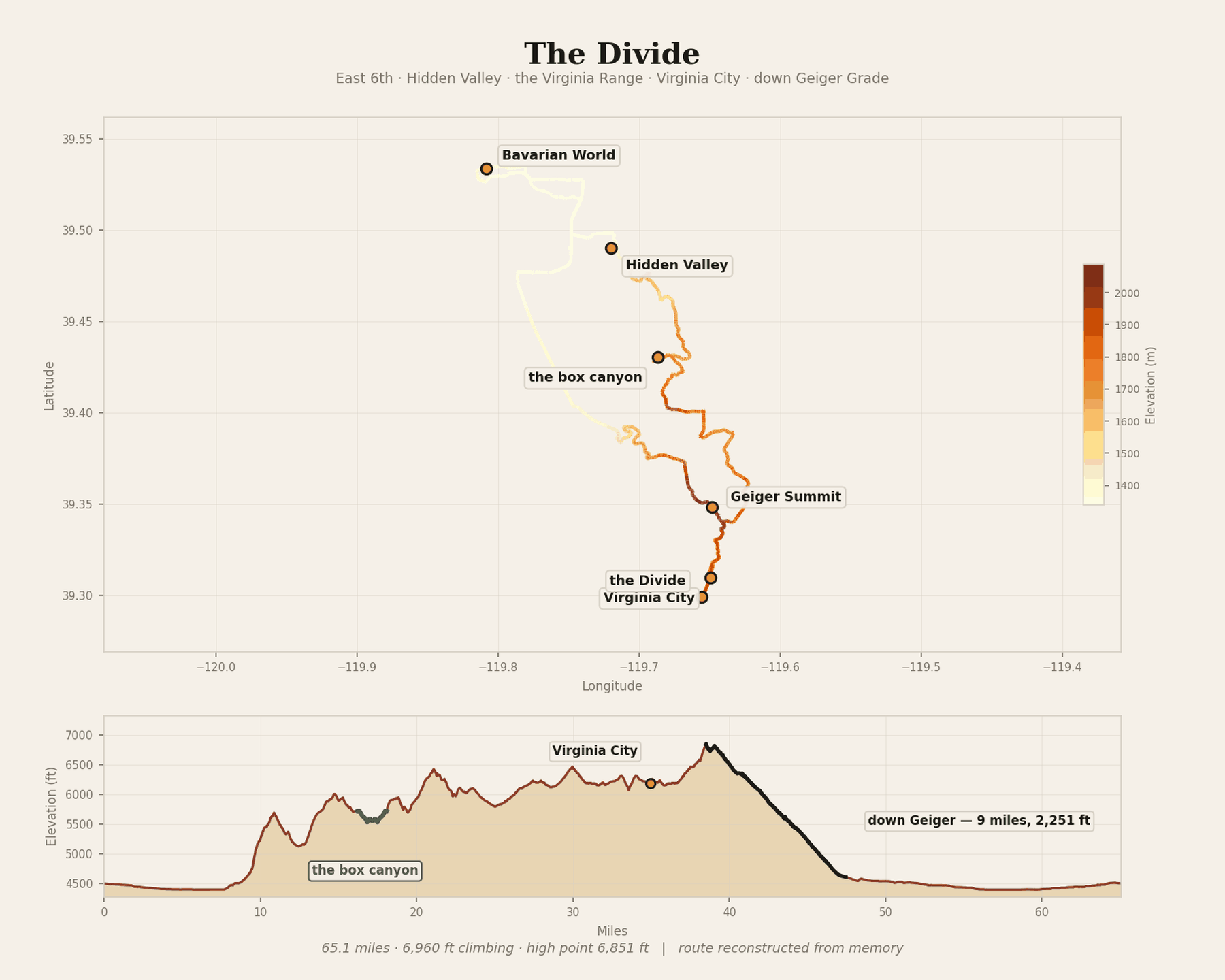
I did not know the numbers at the time. Nobody did — you rode until you were done. Drawing it out, decades later:
The numbers
65.1 miles. 6,960 feet of climbing. Low point 4,393 ft on the valley floor, high point on the route a shade under 6,900.
The box canyon: mile 16 to mile 18. About two miles of ground covered twice.
Virginia City at mile 35. The Divide a little south of it.
And the grade: nine miles, 2,251 feet down, averaging 4.7% with a half-mile at better than seven.
Which puts it right up there with the epics. Longer than the Peavine loop. More climbing than most of them. And I only ever did it once all the way through — I rode variations of the front half plenty of times, but never again the whole thing to Virginia City and over the top.
Alone, of course. All of these were. Not many people I knew could keep up on the long ones, and fewer wanted to. Endurance riding out into the desert is a solitary business and I was never once sorry about that.
I told the story afterwards over as many beers as I could get away with.
Everything out there is something somebody left
That is the part I keep coming back to, and it took me about thirty years to notice it.
The roads I rode were built to get ore out. The town at the top is what is left of thirty thousand people who came for silver and went when it stopped. The holes in that mountain go down three thousand feet because somebody dug them, by hand, in the dark, for wages. The road I came down was built to carry money to the valley. The saloon I drank in was built on the ashes of the fire that nearly ended the place, over the top of another saloon that nobody remembered was there. Even the name of the man they sell postcards of up there was invented in a newspaper office on C Street by somebody who needed something to sign.
And ten gallons of water under a juniper tree in a box canyon, put there by a person I will never meet, for a person they would never meet.
That is the only one of those things that was left for me.
I have thought about that note ever since. Somebody came back out there eventually — a week later, a month later — to check on their water. And found it lighter than they left it, and a piece of paper under a rock, from a stranger on a bicycle who had been in trouble and was not any more.
I wonder what they made of it. I wonder if they laughed. I wonder if they read it standing up in the heat with the insects ticking in the junipers, the way I had been standing a few weeks before.
I wonder if they topped it back up.
I hope they did.
Anyway. Home, cleaned up, lying there with the ceiling going round and my legs still humming, already thinking about the next one.
Wondering what it would be like to ride down Six Mile Canyon instead. Out the other side. Off into that desert I had been looking at through the window, and just keep going.
The Divide
Reno · the Virginia Range · Virginia City · mid-1990s