For this one I just wanted to see if I could do it.
There was no mystery to solve. Peavine was a mountain I looked at every day without knowing what was on top of it. This was the opposite — I knew exactly what was out there, and had known for years, because everybody does. You grow up in California and the Donner Party is not history so much as furniture. It is simply in the room.
What I did not know was whether I could ride to it.
I had no car. I wanted to go to Truckee. And there was a back way in.
Old school style
I plotted the whole thing out ahead of time on old Forest Service maps, tracing the roads by hand. Every spur, every junction, the whole route drawn out old school style, because that is what there was.
I was in decent shape. I had the Paragon. I had the ten essentials and all the regular supplies. And I thought I could make it go.
What was actually under the route
Dog Valley Road is not near the Donner Trail. It is the Donner Trail, in its first form.
The Stevens-Townsend-Murphy Party got the first wagons over the Sierra in 1844, forced through the Truckee River canyon — the brutal way, the way the interstate goes now. In 1845 the mountain man Caleb Greenwood blazed an alternative: out through Verdi, over Dog Valley, down to the lake, avoiding the canyon entirely.
In 1846 the Donner Party came that way. This road. Their catastrophe happened later and higher, trying to get over the pass west of the lake in the snow.
Afterward the same ground became the Dutch Flat & Donner Lake Wagon Road, a toll road hauling supplies to the Comstock through the 1860s. In 1913 it became the original Lincoln Highway, the first road across the country. In the twenties it was the Victory Highway. In 1927 US 40 finally opened through the canyon and the old road was demoted to a Forest Service track, which is what it still is, and what I rode.
Indian trail, emigrant trail, toll road, Comstock supply line, Lincoln Highway, Victory Highway, forgotten dirt. The same physical ground the whole time.
It had to be that way
I started at four in the morning, and it had to be that way.
The heat, first. And then the thunderstorms, because the Sierra in summer will build a cell over your head in the middle of the afternoon and there is nowhere out there to be when it does. The mountains are fickle like that. You go early or you do not go.
A Tuesday or a Wednesday, I think. Out the door and west toward Verdi in the dark, and the first thing you notice at four in the morning in the high desert is that the air has weight to it. It comes off the river cold enough to make your hands ache on the bars for the first mile, and it smells like wet stone and sage and somebody's lawn sprinkler running somewhere in the dark.
Nobody out. A newspaper truck. The traffic lights cycling green and red for an empty street, patient, running their program for nobody. You get the whole city to yourself for an hour if you are willing to be awake for it, and almost nobody is.
Legs cold and stupid for the first twenty minutes, the way they always are, and then somewhere around the west end they wake up and remember what they are for.
The boundary
The Von Schmidt monument sits at Verdi where California becomes Nevada, and I stopped and looked at it, because what an amazing bit of history to just be standing there at the side of a road.
I admired it and moved on. That is generally the correct way to handle a monument at four-something in the morning with seventy miles still in front of you.
When California came into the union in 1850 its eastern boundary was decided at a convention, by men looking at a map. North of Lake Tahoe the line would follow the 120th meridian. Below that it would run diagonally southeast to the Colorado.
Drawing that on paper took an afternoon. Finding it on the ground took another hundred and thirty years.
Nobody involved had any real idea what was out here. The convention did not know, for instance, that the point where the 120th meridian meets the 39th parallel — the hinge of the whole boundary, the corner where the line turns — sits out in the middle of Lake Tahoe, in the water, where you cannot put a stake in it.
For twenty years the surveys were piecemeal and underfunded and contradicted each other. Six different attempts put the 120th meridian in six different places. Tax collectors from two states showed up at the same ranch. At one point it came to actual violence between competing jurisdictions, over a line neither side could locate.
So in 1872 Congress finally paid for a real survey, and the man who got the contract was Allexey Waldemar Von Schmidt — Russian-born, came over for the Gold Rush in 1849, stayed in San Francisco and became one of the engineers who built the place. Water systems, harbor works, the tidal surveys that turned marsh into buildable city. Then, at fifty-one, he took a contract to walk a line from Oregon to the Colorado River.
The hard part is longitude. Latitude you can get from the sun. Longitude is a clock problem: you need to know what time it is in Greenwich at the exact moment it is local noon where you are standing, and the difference gives you the answer. In 1872 that meant carrying a chronometer on horseback across the Sierra and trusting it.
Von Schmidt knew this. He wanted to use the telegraph — run a wire, tap a time signal, get it right. He was overruled.
He walked the line anyway, all the way, setting markers of stone and wood and iron at roughly one-mile intervals, and he was the only surveyor who ever did it thoroughly. This iron obelisk went in where he calculated the 120th meridian crossed the road — the Henness Pass Road, then the busiest way between the two states.
Which is the road I was standing on. Dog Valley Road is what they call that stretch now.
He was off. Not by much — three-quarters of a mile at the southern end, and the argument about the northern section ran for over a century. But here is the part I like: the line was wrong and it stayed. Too much had been built on it. Deeds, fences, county lines, tax rolls, a hundred years of people acting as though it were true.
In 1980 the Supreme Court finally settled it and made Von Schmidt's line the official boundary north of Tahoe. A man on a horse with a bad clock in 1872 drew a line slightly in the wrong place, and in 1980 the highest court in the country ruled that the wrong place was now the right place.
Four of his markers still stand north of Tahoe. This is one of them, in an iron cage beside a Forest Service road, marked 120 degrees west of Greenwich on one face and the distance to the Oregon line on another — 170 miles, 47 chains. A chain is sixty-six feet. He measured the west with a length of iron links dragged over the ground.
The pavement ended a little way out of Verdi, and from there it was dirt for a long while.
All kinds of roads
It was rough, then nice, then rough again, then gravel. All kinds of roads on one road.
You learn a road through your hands and your backside before you learn it with your eyes, and this one had a whole vocabulary. Hardpack that hums. Washboard that comes up through the fork and sets your teeth going and does not stop until you find a line out of it. Loose decomposed granite that shifts under the front wheel like sugar and asks you politely to think about your weight distribution. Then a stretch of old pavement, cracked and grass-grown at the edges, smooth as a table for two hundred yards and then gone again.
The Paragon handled every bit of it, which by then I expected. That bike never once gave me a reason to doubt it.
It got light while I climbed. Not sunrise — the sun was still behind the Virginias somewhere east of me — but that gray pre-dawn where the shapes come back first and the color follows twenty minutes later. Sagebrush and bitterbrush low down, and then the first Jeffrey pines, and the smell changing over from dust to pitch as I gained elevation. That is a real transition and you can smell exactly where it happens.
It was hard and it took time, and there was route-finding to do — a couple of places where the map in my hand and the ground in front of me had to be argued into agreement. Standing over the bike at a junction in the half-dark, turning the paper around, looking at a road that was not supposed to be there.
And then the valley itself, which is beautiful, and bigger than you expect it to be. It opens out under you all at once and just keeps going, meadow grass silver-gray with the dew still on it, pines standing around the edges of it like they are waiting for something.
The grade I did not ride
Emigrant diaries describe the drop into Dog Valley as a tremendous steep into a small valley. Wagons locked their wheels and slid down it rather than rolling.
I did not ride that. Looking at the GPS track afterward, my route runs along the rim and over the top at 6,615 feet without dropping into the valley floor. I was on the edge of the thing, not down in it.
Which is worth saying plainly rather than borrowing somebody else's steepness. The hard part of my day was somewhere else entirely, and it was still ahead of me.
Oddly empty
Then the water systems, which I did not expect to think about as much as I did.
You come up on these enormous engineered lakes out in the middle of nothing and you start wondering what they are for, why they are here, who decided, and what this all looked like before somebody put them in. Somewhere under that flat gray water there is a canyon with a creek at the bottom of it that nobody alive has seen. There was logging going on out there too — I am fairly sure I passed an operation, that particular smell of fresh-cut conifer and diesel that carries a long way in cold air.
And then the pavement.
The road around the dams is beautiful. Genuinely excellent asphalt, wide and smooth and black, laid out through country where there is nobody to drive on it. After twenty miles of washboard and gravel it comes up under the tires like silk, and the noise the bike makes just stops — that constant grinding rattle you have stopped hearing because it has been there for hours, and then it is gone, and the silence of it is almost startling.
You go faster than you should on a surface like that. You cannot help it. The Paragon on smooth pavement with a tailwind at six in the morning, after all that dirt, felt like being let off a leash.
It made no sense to me then and it makes no sense now. Somebody built a first-class road out to a place with nobody in it, and I am glad they did, and I am not going to ask any more questions about it.
No people out there. Maybe a Forest Service truck sitting somewhere checking on something. No boats, nothing on the water, nobody camping that I saw. The lakes lay there absolutely flat with mist coming off them, so still you could see the whole ridgeline upside down in the water. At that hour it was oddly empty, and the emptiness is most of what I remember.
Stampede and Prosser are both mid-century Washoe Project reservoirs — twentieth-century water engineering laid directly over the old wagon road corridor.
So the modern infrastructure is stacked on top of a route that is a hundred and eighty years old. Parts of the original road are still visible here and there, though it has been rerouted and rebuilt so many times that it is hard to say what is original and what is just the most recent version of the same idea.
Coming in from the north
I made Truckee around eight, which was good time.
You come in from the north and drop down into it, over the freeway and into town. It was not built up then the way it is now — I think there are whole developments where I rode in.
And the town was just getting up. That is the thing about arriving somewhere at eight in the morning under your own power: you catch a place doing its private business before it has put its face on. Somebody hosing down a sidewalk. A delivery truck backed up to a restaurant with its hazards going. Two guys standing outside the hardware store with coffee, not talking, just standing there the way men do at that hour. Smell of bacon out of a vent and pine smoke from somebody's stove even in summer, because it gets cold up there at night and always has.
I came in off a mountain covered in dust with my legs shaking slightly and got off the bike into all that ordinary morning, and it was the strangest and best feeling of the whole day.
Coffee and breakfast. And then a bookstore, the kind of bookstore a mountain town has, and I bought an Edward Abbey I had not read yet — Down the River, the essays, river country and the Colorado. The right thing to be carrying, though I did not think about that at the time. I just wanted something to read.
I told them what I had done to get there. They thought I was crazy.
And maybe I was. Still am. But it was a good ride up there.
The height of the snow
I had been to Donner Lake many times. Run around it, ridden around it. This time I went straight to the memorial.
The thing about that monument is the pedestal. It is built twenty-two feet high because that is how deep the snow was the winter the Donner Party was trapped there. You do not read that on a plaque and file it away. You stand at the base and look up at the top of it and understand, in a physical way you cannot get from a book, exactly what those people were inside of.
And it was beautiful that morning. One of those Sierra days that does not seem like it should be allowed — air so clear it has no color at all, the kind you can see thirty miles through, sun coming down through the Jeffrey pines in long solid bars with the dust turning over in them.
The lake absolutely still. Not a boat on it. Granite going down into green water and then blue water and then dark, and the peaks standing up behind it with the last of the snow in the shaded gullies.
I sat down on a dock and took my shoes off and let the sun get at me.
That is a specific pleasure and I want to be exact about it. You have been cold since four in the morning. Your legs have been working for four hours. Everything is damp — jersey, shorts, the back of your neck. And then you sit on warm wood in full sun and the heat comes into your shoulders and your thighs and your bare feet, and the shivering you have been doing without noticing finally stops, and you go completely stupid with contentment for about twenty minutes.
Water noise against the pilings. Somebody's dog barking a long way off. A jay working the pines behind me, complaining about something the way they do.
There were a few people around by then, but Truckee was only just starting its day.
And I had already been through this giant epic.
That is the part that has stayed with me. Not the horror of the history — I already knew the history, everyone does. It was the ordinary morning happening on top of it. People getting coffee. A town waking up. And a monument in the middle of it measuring out a snowdrift from a hundred and fifty years ago.
I sat on a dock by the lake and rested and thought about how far I had come, and about how all of it was still between me and the house.
No choice but to continue
Here is the thing about an out-and-back that I did not fully appreciate when I drew it on the map.
Dog Valley is not a hill you climb. It is a hill you climb twice.
Going out it comes at mile eighteen, on fresh legs, in the cool dark, with the whole day ahead of you. Coming home it comes at mile fifty-nine. And it is the same climb. The mountain has not gotten any smaller while you were at the lake buying a paperback.
The return was easier in one specific way: I knew the roads now. All that route-finding I had done on the way up was solved, and I could just ride, which counts for more than it sounds like. No stopping at junctions. No turning the map around. Just the road, which I had already met once and could now treat as an acquaintance.
But the climb was the climb.
And the country had changed on me while I was at the lake. The cold was gone out of it. The pines had been throwing shade at dawn and now they were throwing heat, resin cooking off them, that hot-pitch turpentine smell that means the day has committed to something. The dust I had ridden through in the dark had turned into dust I could see, hanging in the air behind me, settling on my arms where the sweat was.
Grasshoppers going off in the dry grass like somebody shuffling cards. Everything with any sense already lying down in the shade.
It was hard. But I had water, and I had strong legs, and there was really no choice but to continue.
That is the whole thing, right there. On Peavine I asked myself why the hell I was doing it, over and over, because it was a legitimate question with a possible answer — I could always turn around and go down the front side into town.
Out here there was no version of the day that did not involve going back over that mountain. Home was on the other side of it. The question does not come up, because there is nothing for the question to do.
And then over the top, finally, and the reward for all of it: a long descent with the whole Truckee Meadows opening out brown and hazy in front of you, and the air getting warmer and thicker every hundred feet you drop, sage coming back into it, the pines thinning out and quitting.
You do not pedal. You just steer and let it happen and try to keep the bike out of the washboard. Twenty-some miles of mostly downhill on legs that have nothing left, which is the closest thing to being carried that a bicycle offers.
Verdi again, and the state line, and the little stone marker I had stopped at in the dark that morning, which I did not stop at this time.
And then West 4th.
Which is its own piece of history, and a different kind entirely. That road is the old Lincoln Highway too — the same highway the Dog Valley road used to be, come down out of the mountains and into town. Except here it is not a forgotten Forest Service track with pines growing over it. Here it is dead motels.
Miles of them. The Ponderosa, the El Rancho, places with neon they stopped fixing and a swimming pool full of leaves, all built for people driving into Reno on the only road there was. Then they put I-80 in half a mile north and the traffic simply left, all at once, the way water leaves when you pull a plug. And everything on West 4th has been dying slowly ever since.
So I rode home from one abandoned highway onto another one. The 1846 version had grass growing through it and the 1946 version had a man out front of a motel office at four in the afternoon watching me go past. Same road, a hundred years apart, both of them killed by the next thing.
I did not think about any of that at the time. I was thinking about a beer.
Hot asphalt now, exhaust and gas stations, cars again after a whole day of nearly none. My legs completely finished. Crusted in salt and dust the way you get, arms gritty, that thin high buzz behind the eyes you get at the end of a very long day outside.
Across the street to Bavarian World, and back through the deli and past the dark dance floor to the bar at the back, and Hans.
A liter of something German, sat down at last, and I told him the whole thing. Verdi in the dark. The washboard. The good pavement at the dams that made no sense. The lake with nobody on it, and the monument, and how high the snow had been. Truckee waking up. Then having to go back over the same mountain at mile fifty-nine because there was no other way home.
He listened to all of it, and thought about it for a second, and said what he always said.
Good workout!!
And it was. Seventy-seven miles and seven thousand feet and a hundred and eighty years of road, and that was the correct and complete review, delivered by a man who had probably done a century himself that morning before his shift.
He was the only person I knew who would have understood it without me having to explain why it counted.
What it actually was
I never knew the numbers. There was no computer on that bike and no way to find out beyond a map and some string.
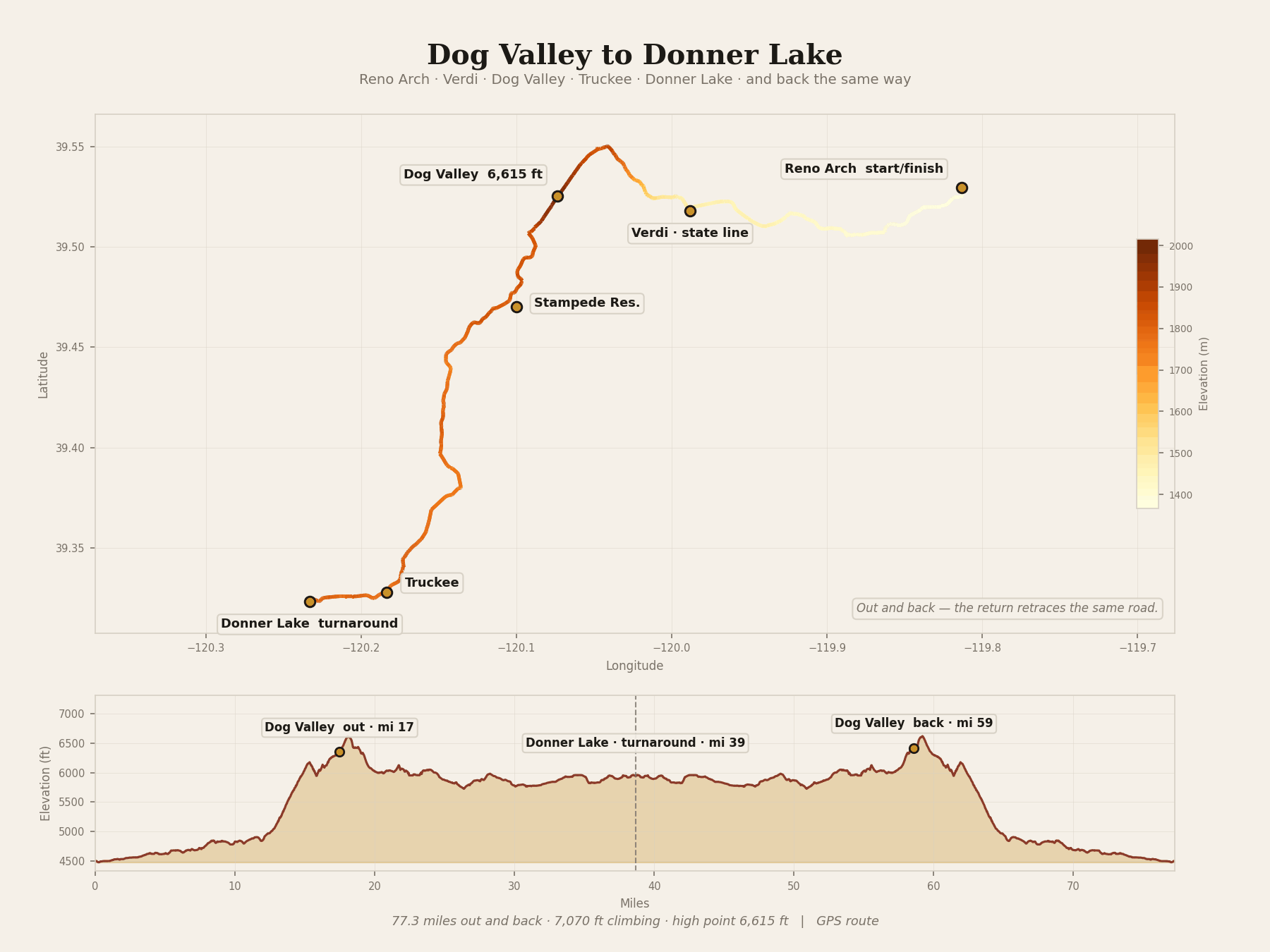
Drawing the route properly, decades later:
The numbers
77.3 miles. 7,070 feet of climbing. Low point 4,482 feet in the Truckee Meadows, high point 6,615 at the Dog Valley summit.
Out at mile 18, Truckee at 36, Donner at 39, and the same summit again at 59.
Four in the morning to somewhere in the afternoon. Alone, out there, getting it done. It was an all-day thing.
Deep thoughts, and also adventure
What I remember first is the distance. Just the scale of the thing, that you could ride a bicycle from your house in Reno to Donner Lake and back in a day, and that nobody was stopping you, and that it simply worked.
The history landed while I was out there, not afterward. It was different from Peavine that way. On Peavine the human history ambushed me — the mining camp, the carved trees, all of it a surprise I rode into. Out here I knew what I was riding toward. The whole point was to go and stand at it.
And standing there is not the same as knowing about it. That is the difference the ride bought me. Peavine put me above my own country, the ground I already half belonged to. Donner put me at somebody else's actual catastrophe, on a beautiful morning, with a bookstore paperback in my pack.
Deep thoughts, and also adventure, and also discovery. That is the honest mix of it.
The smell is what comes back. Peavine is sagebrush and hot dust and that wind that finds you from every direction at once, dry as a kiln. This was the other thing entirely — pine pitch and cold water and wet meadow at first light, air with actual moisture in it, the particular clean of a forest before the sun has got into it.
Two mountains, sixty miles apart, and they do not smell anything alike. You only learn that at about eight miles an hour.
It never ended. It is still out there. Adventure is where you find it.
Wheels Locked, Sliding Down
Reno to Donner Lake · the old road