My mother said: have fun, they put on a good show, but their music is lame.
She had earned that opinion. She was at Berkeley in the late sixties, grew up a few streets from Piedmont, and she used to hang around that band’s house back when they were still calling themselves the Warlocks. Later she was on Haight Street when they were the Grateful Dead and everybody in America was starting to find out about it.
She had been in the room before almost anyone, and her verdict was that the songs were not very good.
She was, as far as I could tell, the only person in Tuolumne County who felt that way.
Somebody bought the Iron Door
You have to understand what the Iron Door is to a town like ours. It is not a bar. It is the economic and social center of gravity, and it has been since before anybody’s grandparents.
18761 Main Street
Built in 1852 as the Granite Store — granite front and back, slate on the sides, one of the oldest Gold Rush buildings left in the Mother Lode and reputedly the only historic building in Tuolumne County built of granite rather than slate.
General store first. Then the town post office for about twenty-five years. It became a saloon in 1896 as Jake’s Place, and got its current name in 1937 from the iron doors on the front — made in England, shipped around Cape Horn, and sold to the saloon as fire protection. When the town burned, you closed your doors and your things survived.
It claims to be the oldest continuously operating saloon in California. The claim is contested only because operating a bar through Prohibition was illegal — though they kept the liquor in the basement, so it may well hold.
It is also the room the Iron Door Irregulars came out of — Hippie Bro, Frank from the Dam, Crazy Irvin, the duct-taped Datsun, the whole loose confederation of adults who ran the back roads of that county through my childhood and are elsewhere in this collection. The bar is the fixed point they all orbit.
So when it sold, the whole town paid attention to who bought it.
They were from the Bay Area. Piedmont, specifically, which is a small strange detail because that is where my father is from, and much later — 2004 — I would find out my half-brother is from there too. Different story. Not this one.
They moved up to a place called Spinning Wheel Ranch, just north of Rainbow Pool, which is the swimming hole everybody in Groveland grew up in. The ranch had its own history in sixties hippie culture that I knew nothing about at the time — a commune of some kind, I think. They were fixing it up. Eventually they did, and it became very nice.
And they had kids about our age.
So we did what kids do. We met them, and they were cool, and that was that.
Dharma and Jessica lived in Piedmont during the week and came up every weekend. Which meant every weekend there was a version of the same day: the parents down at the Iron Door, and the rest of us — me, Josh, Zack, and them — loose in the hills. Smoking weed. Playing hacky sack. Hiking. The river. The ranch. Running around town.
Nobody was supervising anything and nothing bad happened, which is roughly how it worked up there.
What their dad actually did
It came out gradually, the way these things do when you are fifteen and not paying close attention.
The family had a whole other line of work down the hill. Bill Graham Presents — the biggest concert promoter in Northern California. Steve Miller. Huey Lewis. Everybody. And the big one, the one that mattered in our town: the Grateful Dead.
I want to be honest about my comprehension level here. To me it was Dharma’s dad does something with concerts. That was the whole of it. I did not look him up because there was no looking anybody up. You knew what people told you and that was the extent of the file.
What I found out later
Peter Barsotti was the Creative Director at Bill Graham Presents. When he died in 2012 the San Francisco Chronicle headline called him Bill Graham’s right-hand man.
He and his brother Bob were creative directors on thousands of BGP productions across a quarter of a century. If you have seen a photograph of a Bay Area rock show from that era and thought somebody designed that — it was probably one of them.
The Day on the Green sets. An English castle for Frampton and Fleetwood Mac. Beach bunnies with surfboards to bring on the Beach Boys. The Dead’s New Year’s Eve extravaganzas. Ping-pong balls printed with the Stones’ tongue dropped over a stadium during Some Girls. The first Lollapalooza. He is the one who dreamed up putting a music festival at Squaw Valley and having the entire audience ride chairlifts up to it.
When Bill Graham flew over a crowd dressed as an eagle, or came in on a giant birthday cake for the midnight balloon drop — Peter was a few feet offstage in a headset making it work.
He and his wife Bettike bought the Iron Door in 1985. He is the reason the dollar bills came back on the ceiling and the reason it started having live music again.
So the new owners were, as you can imagine, extremely popular in a small mountain town.
Except with my mother, who had known the band personally and thought their music was lame.
An invitation
Somehow — and I have never known exactly how, and at the time it did not occur to me to ask — we were all invited.
Dharma arranged it. Backstage passes. The show was at the Calaveras County Fairgrounds in Angels Camp, which from Groveland is close enough that half the town could get there.
Which is, as it happens, the same short trip out of Tuolumne County into Calaveras that Samuel Clemens made in 1865, in considerably worse weather and with considerably more at stake.
Josh and me and Dharma were going as guests. Zack was going too, but Zack was working it — moving things, setting up, actual labor.
I still have the pass. I found it recently, which is why any of this is written down.
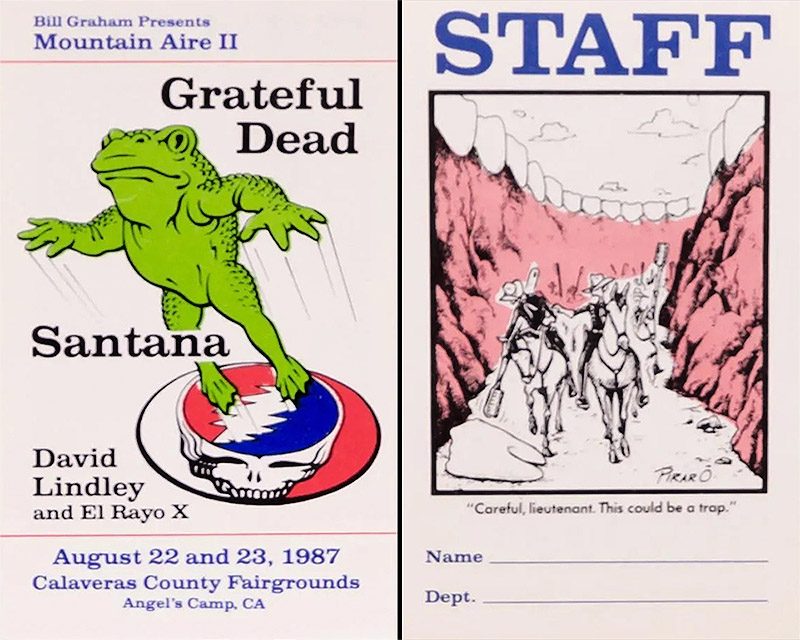
Laminated. Blue block capitals across the top: STAFF.
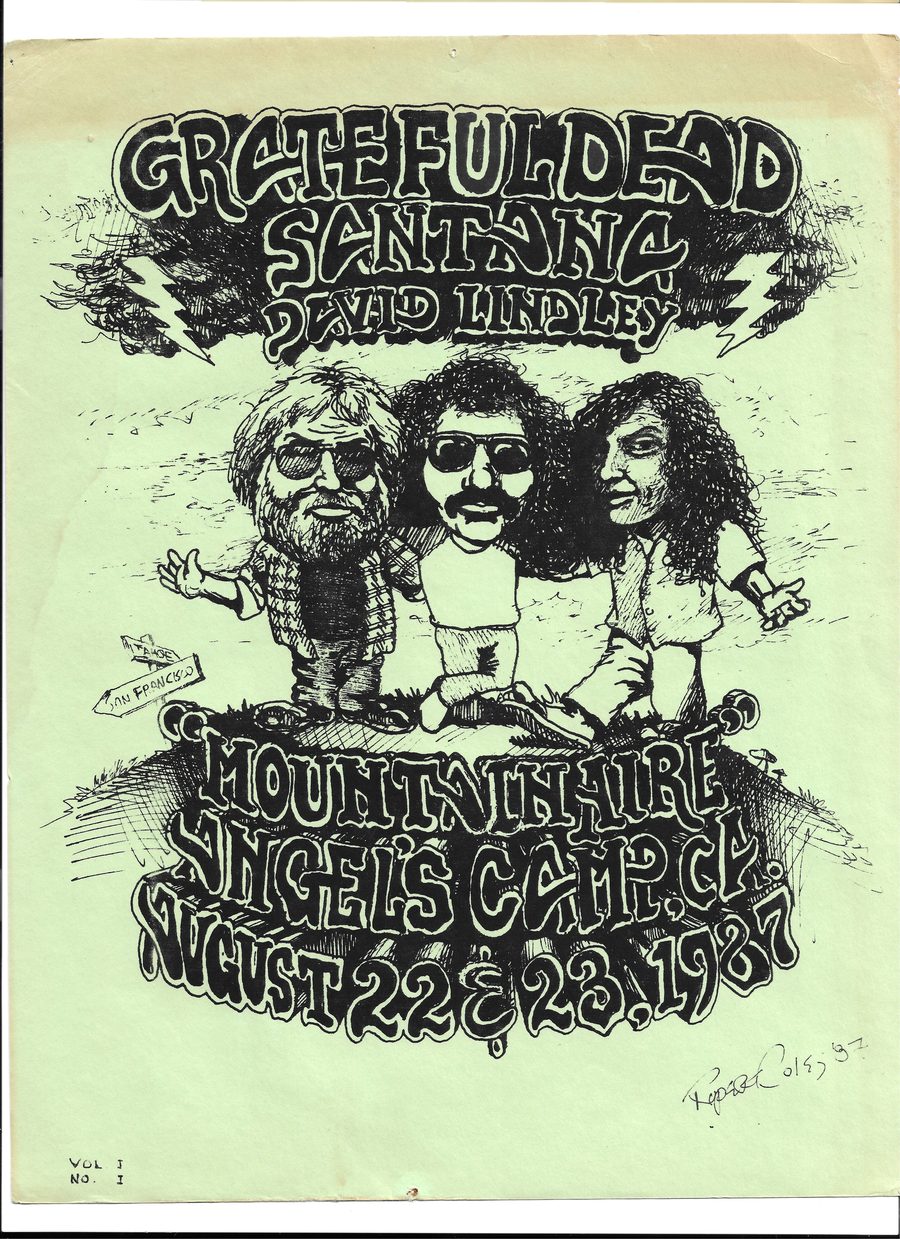
On the front, a green frog mid-leap off a Steal Your Face skull — Angels Camp being Mark Twain’s jumping frog country.
And on the back, a Dan Piraro Bizarro cartoon: a cavalry patrol riding up a canyon that is actually a giant open mouth, teeth for cliffs, a toothbrush where a saguaro should be.
The caption reads: “Careful, lieutenant. This could be a trap.”
It was my first concert. Not my first Grateful Dead concert. My first concert of any kind.
Why a frog
In January 1865 a broke twenty-nine-year-old named Samuel Clemens left a cabin he was sharing on Jackass Hill — which is in Tuolumne County, my county — and went over to Angels Camp in Calaveras. He got rained in for the best part of two weeks.
He spent it at the Angels Hotel listening to miners tell tall tales over drinks, and wrote one of them down: a gambler called Jim Smiley and his frog Dan’l Webster, who could outjump anything in the county until a stranger fed him a handful of buckshot.
It ran in the New York Saturday Press on 18 November 1865 as “Jim Smiley and His Jumping Frog.” It made him. He became Mark Twain on the back of it.
In 1928 Angels Camp paved Main Street and decided the way to celebrate was an actual frog-jumping contest. Fifteen thousand people turned up. Two years later it merged with the county fair, moved to the fairgrounds, and has run every May since.
Which is why the fairgrounds have a nickname, and the nickname is Frogtown.
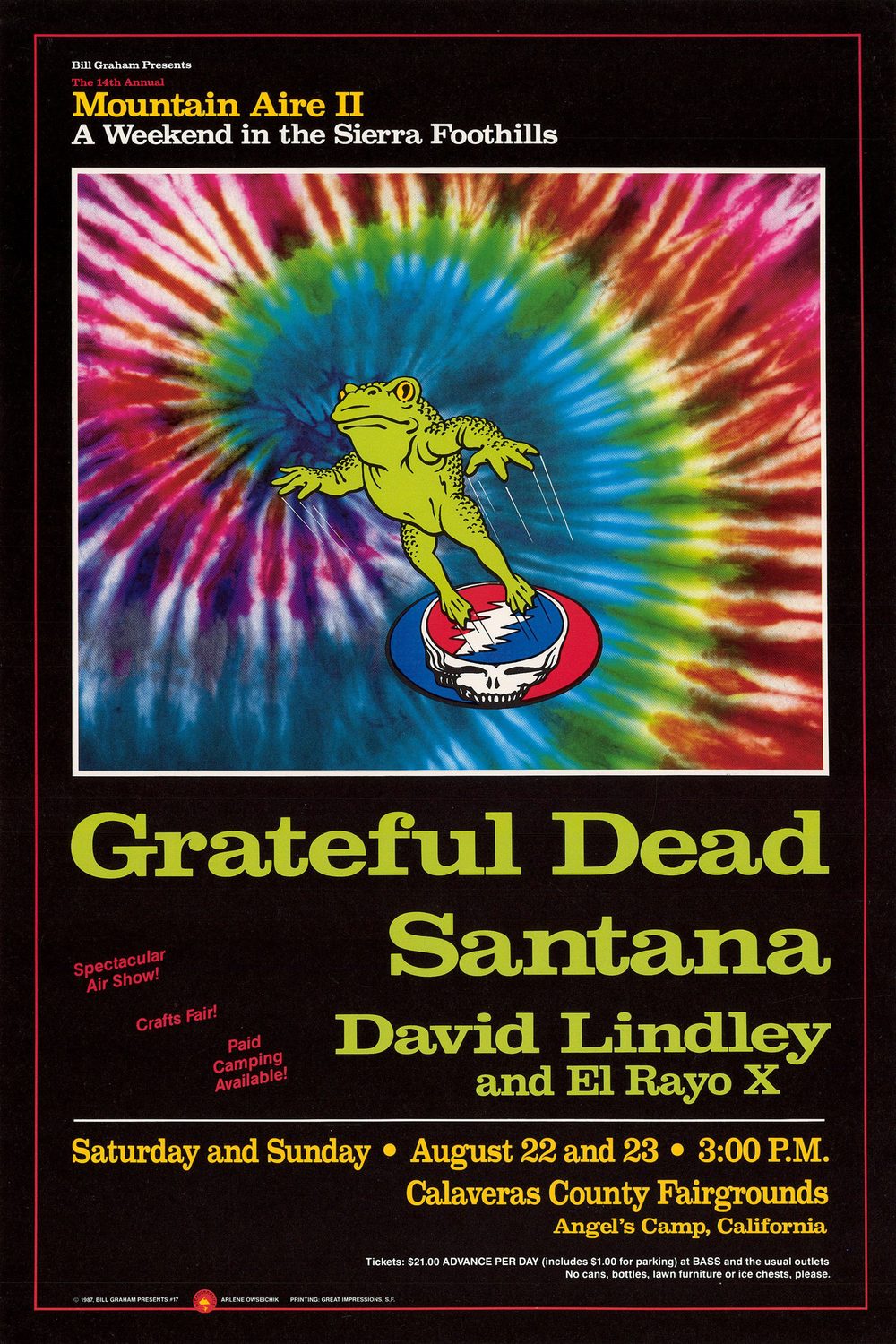
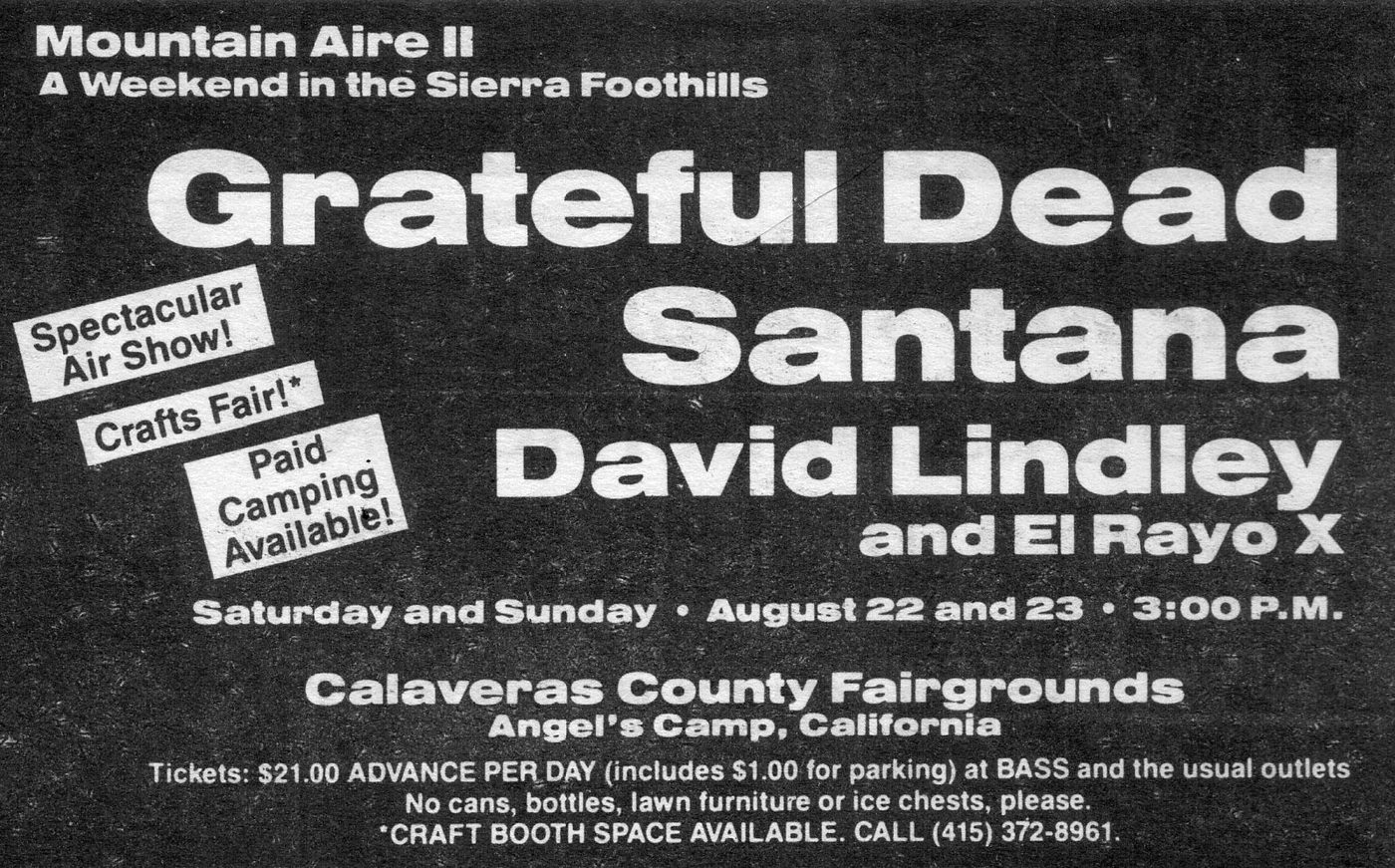
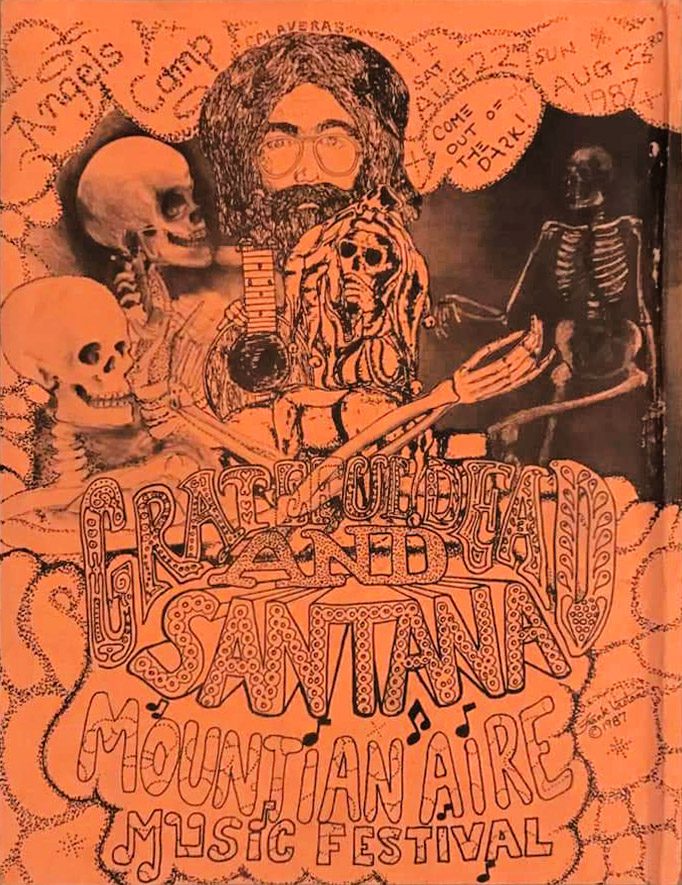
So the leaping green frog on my laminated pass, and on the poster, and on the handbills, is not a piece of psychedelia. It is a hundred-and-twenty-two-year-old local joke. Bill Graham Presents just put it on a Steal Your Face.
Everything it takes
We got there early. It was going to be an all-day thing and then a late-into-the-night thing, and it turned out to be a two-day thing.
And the first thing that hit me — before any music, before any crowd — was the sheer scale of the operation.
Stages going up. Infrastructure everywhere. Trucks and cable and scaffold and the number of people it takes to build a temporary city in a county fairground. All of it happening at speed, by people who clearly did this for a living and were not remotely relaxed about it.
It looked like hard work. That is the part I did not expect, and it is the part that stuck.
I was seventeen and had never seen the back of anything. I had only ever seen finished things. This was the first time I understood that the finished thing is the smallest part of it.
Then the gates opened.
A sea of tie-dye pouring into the grounds.
Not arriving. Pouring. Drums going almost immediately. Vans parking anywhere. An entire culture unpacking itself onto a fairground in the space of about twenty minutes, at an hour when nothing had started and nothing was scheduled to start for a long time.
The party was fully on at nine in the morning.
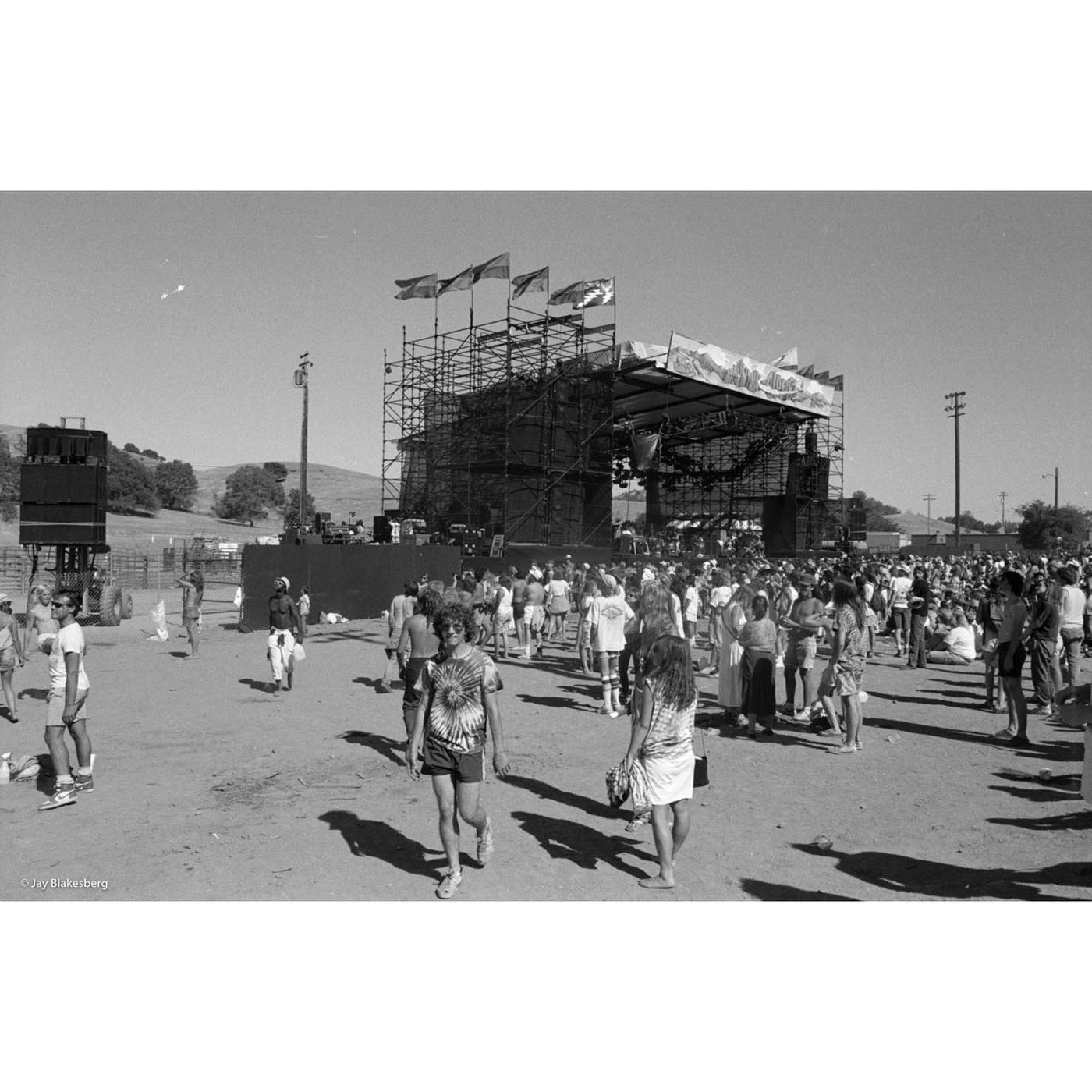
It was, honestly, a little overwhelming. And it was the first moment I was glad about the plastic thing around my neck, because we could step out of it whenever we wanted, and most people could not.
Where the action was
The lot at a Dead show is its own event. Merchandise, paraphernalia, food, drugs, and a general commerce that had clearly been running for twenty years without anybody’s permission.
Dharma had an actual job out there, which I found impressive at the time and still do: checking whether merchandise was licensed. Licensed goods could be sold inside; unlicensed had to stay outside the venue. How rigorously any of that was enforced in a parking lot in Calaveras County, I could not tell you.
So there we were, three teenagers walking a Grateful Dead parking lot on official business, inspecting t-shirts.
We also bought a bag of mushrooms.
I am not going to pretend otherwise, and I am not going to make a production of it either. It was 1987, it was a Dead show, and we were seventeen. There was probably acid too. The mushrooms are what I remember.
A man with crayfish
The lot got intense, so we went back through the fence, which is a thing I had not been able to do before in my life and have rarely been able to do since.
And backstage we met Bill Graham.
He was wearing enormous sunglasses. He was holding crayfish — I have no explanation, there must have been a creek nearby — and he was running around with them like a kid who had found something and needed to show somebody.
Fifty-six years old, in the middle of his own festival, delighted.
He was completely in his element and completely unbothered by three teenagers standing there, and he told us to have a great time at the show. And then he said he had something special planned.
He told us to keep looking up.
We took this seriously, because when a grown man in giant sunglasses holding crayfish tells you he has something planned, you believe him.
We also met Bob Weir’s daughters, who were a bit older than us and knew Dharma and were entirely uninterested in the three of us beyond a quick hello. Which was completely fair and, in fairness, correct.
Aardvark
We walked around the stage while it was still empty.
Sound check. Lights being tested and re-tested. Somebody saying aardvark into a microphone over and over, which I gather is a useful word for checking a mic and a board, and which I have never forgotten.
From up there you could see the other side — the tie-dye wave getting bigger and bigger, people already dancing, a lot of them, to no music at all.
We went everywhere. The mess hall. The chill areas. Past the band’s trailers.
We never saw Jerry Garcia. We saw everybody else, but not him.
The helicopter
Then we heard it.
A big one, coming in over the fairground. It circled a few times — not passing through, circling — and everybody stopped and looked up and got excited.
It landed, and Carlos Santana got out of it.
What a helicopter meant there, then
I did not think any of this at the time. But it is worth knowing what was in the air over those counties in August of 1987.
CAMP — the Campaign Against Marijuana Planting — flew Calaveras and Tuolumne. Both counties are named in CAMP’s own 1984 report. Their season ran late summer into fall, timed to the harvest, which made August peak flying.
So a low helicopter over the Sierra foothills in August was not, in that decade, generally good news.
This one had a rock star in it.
Jerry came in on another helicopter, I think later, though it may all have been closer together than I remember.
Either way, the energy changed. Backstage went from setup to last-minute, which is a completely different pace, and we got out of the way of it. Out front you could feel the crowd tighten up.
It was almost go time.
So we did what teenagers do. We ate the mushrooms.
Keep your eye on the sky
Backstage went eerily calm. That is the part nobody tells you — that right before it starts, everything goes quiet back there, because everyone has done their part and there is nothing left to do.
The PA came on and you could feel the air change. Dry August air with that much power pushed into it crackles. A guitar riff, a couple of tuning notes, and the crowd outside went absolutely bonkers at nothing at all.
But before that — before any of it — everyone was looking up.
There was a plane circling. Not a helicopter. Something else, going around and around, and the crowd was watching it and working out loud whether this was part of the show, whether something was about to happen, what it meant.
And Dharma said: remember what Bill said.
So we did.
And the people jumped out of it.
Skydivers, coming down toward us, making shapes on the way — and I am fairly sure they had the bears. The dancing bears, in colors, coming out of the sky over a county fairground.
They landed backstage.
He had told us. Four hours earlier, holding crayfish, he had told three teenagers exactly what was going to happen and we were the only people in that field watching for it.
And by then the mushrooms were arriving. Possibly they had arrived some time ago. It is hard to reconstruct the order.
Then the music started, and the whole thing became one thing.
The world inside a cup
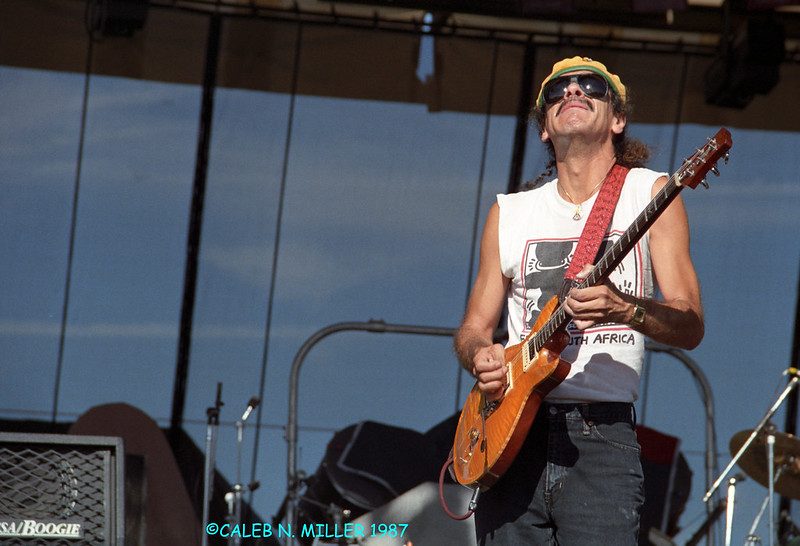
Santana played and the crowd went a different kind of wild. I did not know much about him then and I do not know much now — the big songs, that is about it, not really my scene. But he is a master of the thing he does, and you could hear it even from behind.
It was hot, and there was a great deal happening, so we went to the break area where the staff go, to get some food and reset before the main event.
And that is where I lost some time.
I sat and looked into a cup.
There was a whole world in there. Not a metaphor — a world, with its own scale and geography and weather, going all the way down. I found it to be vast.
And a few steps away, the guitars and the drums were coming up through the ground and into my hands. You could feel them. That volume through that much air moves the dirt you are standing on.
So I was holding the very large and the very small at the same time. The whole universe out there in front of the stage, thirty thousand people of it, and the same thing again inside a plastic cup, and no meaningful difference between them.
That was deep. It is still deep. I have had thirty-nine years to find a better way to say it and I have not.
Then we walked out and looked at the crowd, which was enormous and enthusiastic and doing its own thing entirely, and then there was a break, and backstage went from calm to a rush again as they reset the stage for the Dead.
The sun was going down but it was still, I think, afternoon. With the mushrooms and everything that had already happened, the clock is not something I can vouch for.
The new song first
I do remember the moment they started.
It was Touch of Grey, which we knew, because we had heard the album at Dharma’s house, and because by then it was on the radio.
What we had walked into
In the Dark came out in July 1987, six weeks before this show. Touch of Grey went top ten — the Grateful Dead’s first and only top-ten single — and the video was in rotation on MTV.
Six of the songs played that night were from that album. Nearly a third of the set was material most of that field was still learning.
So this was the precise summer the band accidentally became a mainstream act, and the crowds got enormous and much younger. We were the new generation of Deadheads and there was no way for us to know that, because we had nothing to compare it to.
Colors and waves of people. Seeing the sound, which is a cliché until it happens to you. The energy is the thing I actually remember — not the songs, the energy.
And then Dharma said: let’s go up on the stage. There is an area we can be.
Their side of it
What I remember about walking up there is physical before it is anything else.
The heat coming off the lights. The sound out of the stacks arriving as pressure rather than noise. And the guitar — the guitar was talking. To me, I thought, and probably to everybody, which felt the same from where I was standing.
And then looking out and seeing it from their side.
An ocean of tie-dye.
Everyone dancing. And the colors spinning off the clothes — actually coming off them, lifting away and hanging in the air over the front of the crowd.
The smiles on the band. The smiles out there. All of it one thing, in a county fairground in Angels Camp, California.
I was not the only person out there in that condition. I would guess most of that field was further along than I was. You could feel it. That is the part I keep coming back to — you could feel it.
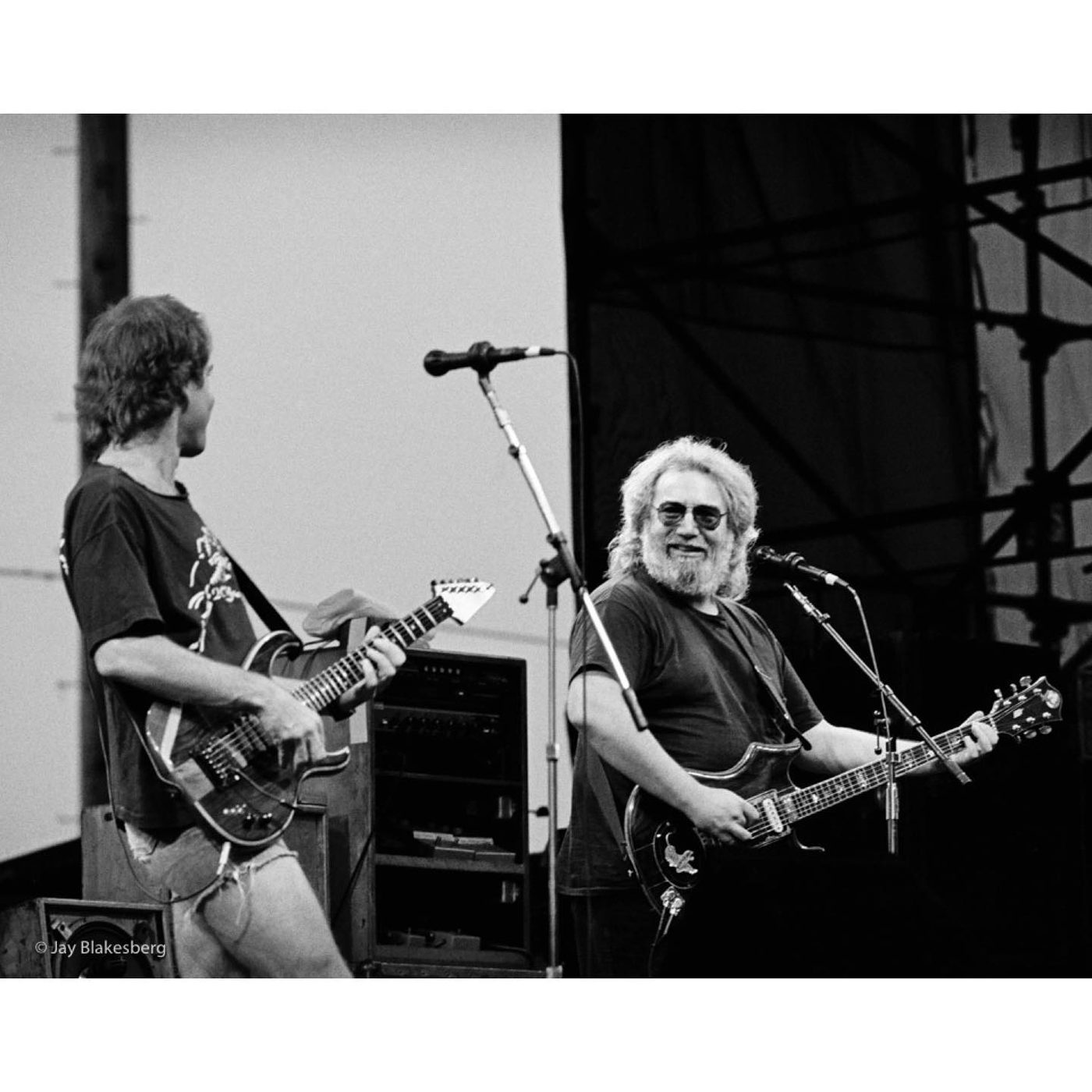
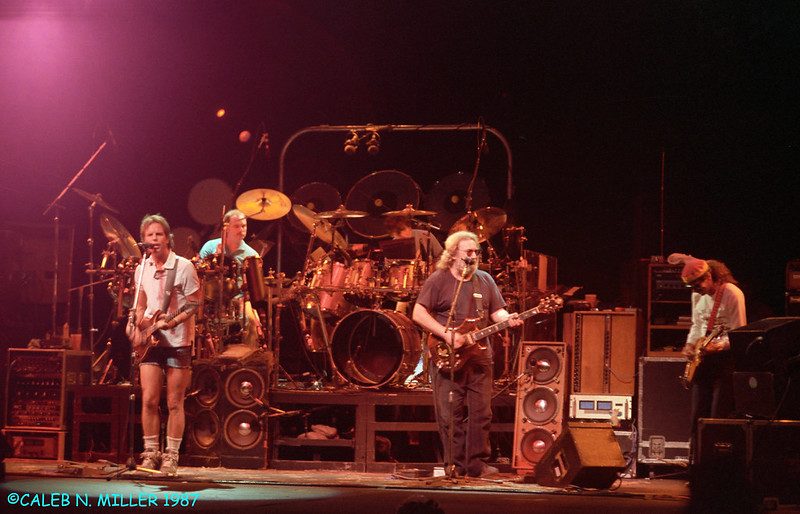
Ten or fifteen feet from Jerry Garcia.
Maybe he looked over. He had the glasses on, so who could possibly tell. It felt like he did. He was just jamming, just talking through the guitar in that way he had, old songs and new ones, and you could see it landing out in the crowd.
I was, as established, quite high.
Maybe today is the day
And standing there, I started thinking: maybe today is the day I just run out on that stage and fly into the crowd.
Just walk out. Or run out. And let go.
It would be easy. That is the thing I want to be accurate about. It would have taken less than thirty seconds to be out there and airborne. Nothing was in the way. Nobody was watching me. The gap between thinking it and doing it was almost nothing at all.
Where that came from
This was not a Grateful Dead impulse. That crowd did not stage dive.
We were also punk kids. Hardcore, SoCal skate culture, against the machine, against the system, all of that. Stage diving was our thing, from a completely different world that happened to be running at the same time in the same state.
So there was a seventeen-year-old standing on a Grateful Dead stage in 1987 feeling the pull of a different subculture entirely, and thinking he might add to it right here, in front of everybody.
I thought about it for what felt like hours and was probably three minutes.
I had the whole vision. And then I had the rest of it.
My friends’ parents gave us these passes. That was a gift. Being up here at all was a privilege that had been handed to me by people who were, at that exact moment, somewhere in this building working.
To dishonor that would be very bad.
And I was extremely high, but I was not so high that I could not do that arithmetic.
So I let it go. I stayed where I was and enjoyed the music, which was amazing, and which sounds completely different from up there — cleaner, and considerably safer than down in front, where I would have landed.
I remember thinking: how lucky am I to be here.
Getting out
The show went late and then it was over, and we rolled out, and that took a very long time.
Because what none of us had understood until we tried to leave was that the entire county was full. Not the fairground — the county. More people than the grounds could hold, more than Calaveras County had any structure for, more than anyone up there had seen before and possibly since.
Hippies across the land, in every direction, all the way out.
And people much further gone than I was. People in the bushes and the trees, genuinely struggling. Somebody’s acid had clearly been good and had clearly gone everywhere. It was intense to drive through.
It stayed like that all the way to Sonora. Then home to Groveland.
I was completely cashed out.
The debrief
We caught up a few days later, because everybody needed to sleep first. Probably at Rainbow Pool, because that is where things got discussed.
And the consensus — arrived at with the seriousness of teenagers reaching a conclusion — was that mushrooms are the better choice for a concert. Better for a social scene, a party, a crowd. Acid is better for looking inward.
This show, we decided, had a bit of both in it.
Zack had his own version of the whole day, from the working side, which was a completely different concert. Josh had his. We compared notes for months. Years, really.
What they played
I could not have told you a single song on that list the following week, and I am not going to pretend otherwise now. But it is all documented, so here it is — the Santana material first, then the Dead’s set in the order it happened.
Santana — the ones I’d have known
- Black Magic Woman
- Oye Como Va
- Soul Sacrifice
- Samba Pa Ti
Grateful Dead — 22 August 1987, in order
- Touch of Grey
- Little Red Rooster
- Tons of Steel
- Friend of the Devil
- My Brother Esau
- Tennessee Jed
- When I Paint My Masterpiece
- Bird Song
- Good Morning Little Schoolgirl ∗
- In the Midnight Hour ∗
- Hell in a Bucket
- When Push Comes to Shove
- Estimated Prophet
- Eyes of the World
- Drums → Space
- The Other One
- Goin’ Down the Road Feeling Bad
- Throwing Stones
- Turn On Your Lovelight
- U.S. Blues
∗ Carlos Santana sat in on both. The first of them was the seventeen-year bustout, and I have no memory of it at all. Drums → Space is improvised and does not exist as a recording of anything, which is rather the point of it.
A playlist of that, more or less. Mostly live recordings, because that is what the Grateful Dead mainly exist as — though none of them are from this night. The only recording of this night is a soundboard on archive.org, and it is linked underneath.
The soundboard, if you want the real thing: archive.org ↗
What I did not know
A few things about that night that I could not have known at seventeen, and only found out much later.
The bustout
Nine songs into the first set they played Good Morning Little Schoolgirl, with Carlos Santana sitting in.
The Grateful Dead had not played that song since 19 September 1970. One thousand one hundred and nineteen shows earlier. It was also the first time Bob Weir ever sang lead on it.
Everyone in that field who understood what they were hearing would have completely lost their minds. I have no memory of it whatsoever. I was seventeen and I had no idea what a bustout was.
On the record
High of 83°F. Low of 57.8. Wind at 13.9 miles an hour. Partly cloudy.
And a moon phase of 0.94 — very nearly full, over the whole thing.
Soundboard recordings of that exact show survive on archive.org. I can listen to my own first concert, including the crowd noise when Santana walks out of that helicopter.
And one more.
The man in the giant sunglasses holding crayfish, who told three teenagers to keep looking up, was killed on 25 October 1991 when the helicopter carrying him home from a Huey Lewis show hit a transmission tower near Vallejo.
Jerry Garcia died in August of 1995, within a fortnight of the eighth anniversary of that Saturday.
Two weeks later
Senior year at Sonora High started about a week after that, and it would turn out to be as epic and as much of a coming-of-age as anything that came before it. There was a great deal still to figure out.
But that concert was the event of that summer. We talked about it for months. Some of us are still talking about it.
There have been a lot of other shows since. Genuinely good ones. None of them were that.
And I still have the pass, which I found in a box, and which is the only reason any of this got written down. Blue capitals: STAFF. A frog on the front. And on the back, that cavalry patrol riding up into a canyon that turns out to be a mouth.
Careful, lieutenant. This could be a trap.
It was not a trap.
My mother was right about one thing, though, and it took me a long time to notice. What I brought home was not the songs.
It was a man with crayfish. Bears falling out of the sky. A whole universe inside a plastic cup. The colors coming off the dancers, and ten feet of empty stage that I did not walk across.
They put on a good show.
These stories come from a specific time and place — the Sierra Nevada foothills, the mid-1980s, a particular brand of teenage freedom that doesn’t exist anymore and probably shouldn’t. They involve substances that were illegal then and mostly still are. I’m not recommending anything. I’m just telling you what happened, as honestly as I can, because some things are too strange and too true to leave unwritten. The places are real. First names only, and nothing anyone told me in confidence. The rest is as true as memory allows.
Keep Your Eye on the Sky
Mountain Aire · Calaveras County Fairgrounds · 22 August 1987